
Module Lead Times in 2026: What Buyers Should Know
You cannot buy your way out of a lead time. Not in modules. A lead-time number is a promise from a factory that is already oversubscribed, and in 2026 it is less a fact and more an opening offer. The buyers who keep shipping are not the ones with the best quote. They are the ones with the second source already qualified, the stock already on hand, and the BOM built to survive a squeeze.
The mid-2026 signal
The signal is mixed, and the mix matters. ECIA’s July survey swung back the wrong way after a brief June easing: lead-time pressure rose to 82 percent of respondents, and in the semiconductor segment every single respondent reported increases. That is the segment that hits a cellular module hardest, because a module is a baseband, a memory, a power tree and a radio, and in the middle of it all there is a chipset someone else allocates.
Demand is not the problem. Astute Group describes the current cycle as the strongest in five years, with some microcontroller lead times pushed past 20 weeks. The problem is that fabs have permanently moved mature-node capacity to advanced logic, and that capacity is not coming back. So the ordinary, cheap, everywhere part you assumed would always be there is exactly the one sitting on an allocation list.
Modules feel it through memory, not silicon
Modules are still shipping. Counterpoint put global cellular IoT module growth at about 4 percent year over year in Q1 2026, and kept the full-year forecast near that flat mark. The interesting part is the reason. Soft consumer demand is part of it, but so is LPDDR4 and memory supply pressure, which raises the cost of the higher-end modules and slows their adoption. The module you buy inherits a memory market you do not see on the module’s datasheet.
That is worth holding onto. If memory tightens, the module lead time moves even when the foundry and the module line are both healthy. A buyer planning a product around a quoted module lead time is planning around a number that a different market can change.
Where 200mm capacity sits now
The capacity story has a geography. Worldwide 200mm wafer capacity is forecast to rise to a record level in 2026, roughly 14 percent above 2023. But a big share of that new capacity is coming out of China, driven by state support. That changes the sourcing map. More capacity does not automatically mean easier buying if the capacity you can actually use sits behind a different export, tariff or policy regime. Second-sourcing is no longer just a resilience habit. It is also a compliance decision.
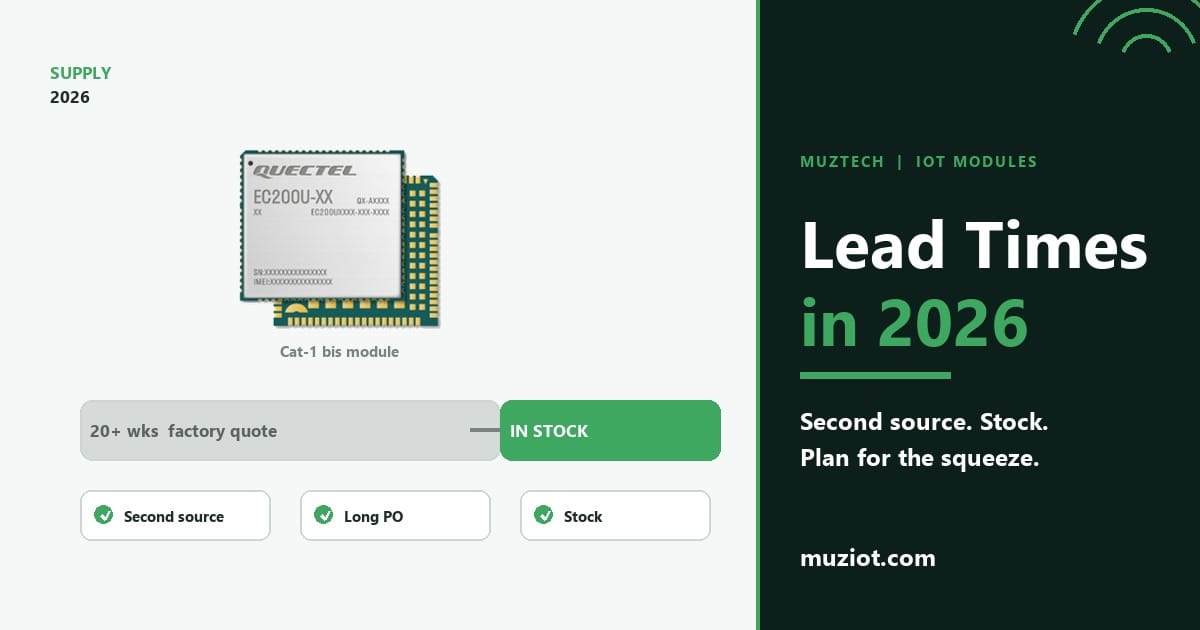
Read a lead-time quote the way a buyer does, not the way a scheduler does. The number covers the module line, the test and burn-in, the packing, the move to a distributor hub, and then your delivery. A factory quote assumes none of that stock exists yet. A distributor quote that says in stock skips most of it. That is the real difference between a 20-week factory number and a three-day ship date: not magic, just finished inventory sitting in a warehouse before you asked for it.
The playbook that actually cuts the risk
There are five moves that separate a buyer who ships from a buyer who waits.
- Qualify a second source during design, not during a shortage. A qualification test inside a squeeze costs you a ship date. Done in development, it costs an afternoon. The form factor guide and the brand comparison are the two places to start, because a pin-compatible part on the same footprint is what lets you switch without a board re-spin.
- Treat the quoted lead time as a floor, not a fact. On parts under formal allocation, plan a buffer of 30 to 50 percent beyond the quote. When a factory says 16 weeks, plan for 22 and be pleasantly surprised.
- Extend your purchase-order coverage. On a tight line, 90 to 120 days of coverage, and a longer-term agreement on the workhorse parts, beats a week-to-week spot buy that re-prices every time the market twitches.
- Carry safety stock on the parts that never change. Stock is a hedge, not a sunk cost. The module you reorder every month is the one to hold deep.
- Avoid end-of-life parts on purpose. A part already coasting toward EOL during a shortage is a double risk. Check lifecycle before you commit, the same way you check the band variant and the certification list.
The trap that costs the most
When lead times stretch, the lure is a same-day price from a source you have never audited. That is exactly where re-marked and recovered stock shows up, presented with a nice photo and no history. The authenticity article covers how to screen it. In a squeeze, the supplier who can show a certificate, a lot code and a wish to be audited is not the expensive option. It is the only option that does not cost you a production run.
What we keep in stock
We carry Cat-1, Cat-4, NB-IoT, LTE-M and 5G modules from Quectel and SIMCom, plus GNSS and antennas, and we hold stock rather than quoting from a list. That is the practical version of a second source: a module you can buy off the shelf on the Quectel range and the SIMCom line. Need the full numbers? Browse the datasheet center, and for 5G Sub-6 start with the RM530N-GL and the RM550V-GL, from a supplier that also screens parts and covers the order. See our approach on the about page.
The short version
Lead times in 2026 are not a weather report. They are a signal to lock in a second source, buffer the quote, extend the PO, hold stock, and buy from someone who actually has the part. Do that, and a 22-week number becomes a scheduling problem rather than a stopped line.
Tell us what you are building and the quantity, and we will pull the stock list and a realistic ship date. Then send us your BOM and we will do the same for the whole line.
Sources
- Electronics360 / ECIA, “ECIA: Summer slump hits electronic component sales” (https://electronics360.globalspec.com/article/24101/ecia-summer-slump-hits-electronic-component-sales)
- Astute Group, “Rising component lead times pressure Q3 manufacturing schedules” (https://www.astutegroup.com/news/general/rising-component-lead-times-pressure-q3-manufacturing-schedules/)
- Counterpoint Research, “5G fuels growth as global cellular IoT module market climbs 4% in Q1 2026” (https://counterpointresearch.com/en/insights/5g-fuels-growth-as-global-cellular-iot-module-market-climbs-4-percent-in-q1-2026)
- IBS Electronics, “China’s mature-node chip expansion in 2026” (https://www.ibselectronics.hk/resources/news/china%E2%80%99s-mature-node-chip-expansion-in-2026-market-impact-risk/)
- PCBSync, “Component shortage sourcing: a supply chain playbook” (https://pcbsync.com/component-sourcing-strategy/)
- A2 Global Electronics, “Q2 2026 market update: sourcing risk is building” (https://a2globalelectronics.com/electronics-news-trends/q2-2026-market-update-sourcing-risk-is-building-across-key-categories/)