
How to Choose a Cellular Module: The Specs and Design Points That Matter
A datasheet is a menu, not a verdict. It lists what a module can do, but it does not tell you whether that module survives in your enclosure, on your power rail, in your region, for the years you plan to ship it. Plenty of products die not from a bad chipset but from a spec nobody checked.
This is the shortlist to run before you commit to a part.
Start with the tier, not the model
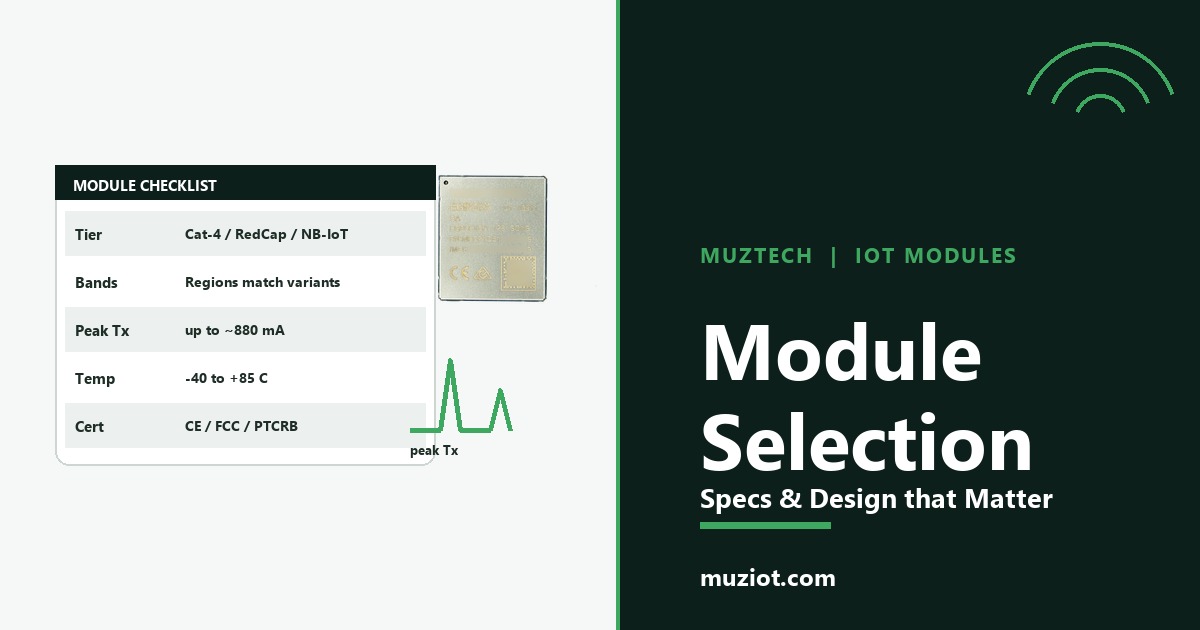
The tier sets the ceiling. LTE Cat-1 bis tops out around 10 Mbps and is cheap. Cat-4 gives about 150 Mbps down and 50 up, which covers most video and gateways. 5G RedCap sits in the middle, built for mid-tier devices that want throughput without full 5G cost. NB-IoT and LTE-M trade data for battery life and deep indoor reach.
Pick the tier from the use case, not from what is trendy. If a device streams or needs near-real-time, lean Cat-4, RedCap or 5G. If it sends a few bytes a day from a basement, lean NB-IoT or LTE-M. The RedCap explainer, the Cat-1 bis versus RedCap comparison, and the LPWAN guide walk through each decision.
The specs that actually matter
Most of the datasheet is noise. These are the lines that change the design.
- Bands, and the right regional variant. EG95-E, EG95-EX and EG95-NA are not the same part; they cover different band sets. Verify the variant matches the markets you are shipping to, not just the family name (EG95, EC25).
- Peak current during transmit. An LTE burst can pull hundreds of milliamps, and a Cat-4 module at max power can draw close to an amp. u-blox lists about 350 mA typical on LTE transmit; a Cat-4 part can hit 660 to 880 mA. That is the number your regulator and battery have to survive, so read the peak, not the idle current.
- Throughput and latency at the tier you chose.
- Mobile-originated power in idle, sleep, and the PSM and eDRX states if it is battery powered.
- Operating temperature. Industrial hardware wants -40 to +85 C, not the consumer range.
- GNSS if the design needs a position, and whether the module carries it.
- Host interfaces (USB, UART, PCIe) and the AT command set.
- Form factor. LGA, M.2 or Mini PCIe changes how you build the board, heat it and service it. The form factor guide covers that.
The non-datasheet specs that decide everything
A few numbers are never on the sheet, and they are usually the ones that sink a product.
- Lifecycle. Is the part active, or already on a notice of discontinuation? A module you design in today could be unsupported in three years. The 2G/3G migration roadmap is the cautionary example: a radio tier can disappear under you.
- Certifications. CE for the EU, FCC for the US, IC for Canada, plus GCF and PTCRB and, in practice, carrier-specific programs such as AT&T Network Ready or Verizon Open Development. Using a module the vendor has already certified saves you a round of RF and regulatory work, which is why this is one of the biggest hidden costs in a design.
- Supply, lead time and price breaks. At volume the MOQ matters as much as the unit price.
- Documentation and firmware cadence. A module with weak docs or rare firmware updates is a liability.
The design points that kill a project
Choose the right module and you still have to mount it and feed it.
- Antenna. Count the radio ports (2×2 versus 4×4 MIMO), match the connector (U.FL versus MHF4), and get the placement right. RF is validated in the real enclosure, not on a workbench.
- Power. A module that draws 900 mA on a burst needs a supply with margin, proper decoupling, and protection against brownout. Under-sizing the peak is a classic field failure.
- Thermal. A 5G baseband chip should stay below about 95 C. That means a thermal pad, a heatsink, or a well-designed copper path, and accounting for duty cycle, not a single burst.
- SIM and eSIM. For fleets that move across operators or borders, an eSIM with remote provisioning avoids touching hardware. The eSIM guide covers the module side.
- EMC, ESD and grounding. A cellular transmitter is an RF source; plan the shield and the ground return early.
The decision workflow
- Fix the tier from the use case.
- Shortlist two or three vendors and models.
- Verify the regional band variants.
- Check lifecycle and certifications.
- Size the power, thermal and antenna path in the enclosure.
- Prototype on a dev board before committing the final layout.
- Lock the BOM and get a quote.
Common mistakes
Picking on price alone. Ignoring regional variants. Under-sizing peak current. Assuming a module stays in production forever. Skipping antenna validation in the real enclosure. Missing a carrier certification. Any one of these turns a reasonable module into a recall.
The short version
The datasheet answers what a module can do. The tier, the bands, the peak current, the certification list and the lifecycle answer whether it survives in your product. Get those five right and the rest is detail.
We carry cellular modules from Quectel, SIMCom, u-blox and others across Cat-1 bis, Cat-4, NB-IoT, LTE-M, RedCap and 5G, in LGA, M.2 and Mini PCIe forms, plus antennas and pigtails. Tell us the region, the use case and the enclosure, and we will narrow the list for you.
Sources
- Soracom, “Choosing the right cellular module for your IoT deployment” (https://soracom.io/choosing-the-right-cellular-module-for-your-iot-deployment/)
- Digi-Key, “4G LTE Cat-4 transceiver modules – transmit current” (https://www.digikey.com/en/products/filter/rf-transceiver-modules-and-modems/4g-lte-cat-4-at-t-verizon/872)
- u-blox, “LARA-L6004-00B – LTE Cat 4 module” (https://componentsearchengine.com/part-view/LARA-L6004-00B/u-blox)
- Telit, “LE910C1-NA design manual – max transmit current” (https://www.manualslib.com/manual/2533605/Teli-Le910c1-Na.html)
- Aeris, “Device and application certification” (https://support.aeris.net/hc/en-us/articles/360036905053-Device-and-Application-Certification)
- Geotab, “Compliance and telematics technology certification” (https://www.geotab.com/blog/compliance-telematics-technology-certification/)
- Quectel, “RG255C-GL hardware design – recommended thermal design” (https://www.manualslib.com/manual/3398037/Quectel-Rg255c-Gl.html)
- 1OT, “Cellular module selection for fleet OEMs” (https://www.1ot.com/es/blog/cellular-module-selection-for-fleet-oems)