
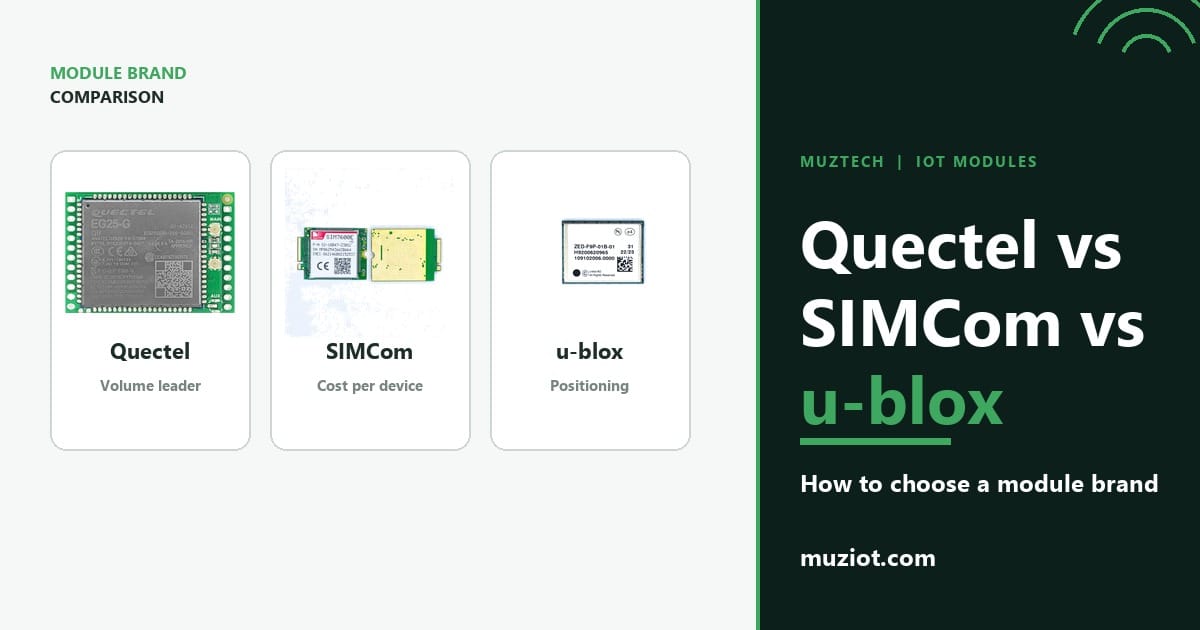
Quectel vs SIMCom vs u-blox: How to Choose a Module Brand
Three names sit at the top of most module quotation sheets: Quectel, SIMCom and u-blox. Each builds solid hardware. They do not build the same kind of hardware, and they are not exposed to the same risks. The useful question is not “which brand is best.” It is which brand is best for this design, this region, and the years your product has to stay on the market.
The market is concentrated, and that matters
This is a small club with big members. Berg Insight put the five largest cellular IoT module vendors by revenue in 2025 at Quectel, Fibocom, Telit Cinterion, MeiG and China Mobile IoT, together holding 73 percent of the market, on total revenue up 19 percent to about 5.6 billion US dollars. IoT Analytics puts Quectel alone at roughly 34 percent of 2025 revenue. That concentration is not trivia. It decides who holds the R&D budget to keep a part alive, who gets the first allocation when a chipset launches, and who can hold a price when supply tightens.
Quectel: the volume leader you should assume is in the running
Quectel is the default answer for a reason. It spans nearly every tier a buyer needs, from NB-IoT and LTE-M through Cat-1 bis and Cat-4 up to RedCap and 5G, and it ships in LGA, M.2 and Mini PCIe (the EG95-E in LGA, the EM05 in M.2). The catalog is enormous, and so is the regional mapping: an EG95-E, an EG95-EX and an EG95-NA are different parts covering different band sets. When a customer has already qualified it, when you need a second band variant without a board redesign, or when you want one vendor across many projects, Quectel’s breadth is the winning argument.
That breadth brings two things to watch. The first is that the catalog is so big you have to confirm you are not quoting a part already sliding toward end of life. The second is governance. For some US-carrier and government-adjacent programs, vendor country-of-origin is now a genuine line on the compliance checklist. It blocks some projects and not others. Ask it early. Do not use it as a reason to skip the brand.
SIMCom: the price and time-to-market play
SIMCom is usually the name left standing once the spec is settled and the budget is not. Compare the exact module variants before considering a second source. Check the pinout, supply requirements, RF layout, interfaces, AT commands, firmware and approvals; a similar footprint does not establish drop-in compatibility. SIMCom also fields 5G modules in the SIM8200 and SIM8260 families and a GNSS line that includes the SIM68M. For a high-volume, cost-driven product shipping on a predictable schedule, SIMCom delivers the strongest price per connected device.
The trade-off is depth. SIMCom does not match Quectel’s sweep of global carrier certifications or its long tail of regional band variants, and the documentation can be thinner. If your device must pass a specific US carrier program or a niche band, verify it model by model rather than trusting the brand name.
u-blox: the positioning benchmark, and a lesson in lifecycle
For positioning designs, compare the exact u-blox module and lifecycle status. MAX-M8Q is an older-generation GNSS module; NEO-6M is an older-generation GPS module. Our u-blox GNSS module index, including MAX-M8Q and NEO-6M groups these legacy part numbers. It is not an individual datasheet or a stock confirmation. The NEO-7M page is a separate reference. Check the exact ordering code, documentation and qualification requirements for the intended design.
u-blox also demonstrates why lifecycle belongs on the checklist. In 2025 the company exited cellular IoT modules to concentrate on positioning and short-range. Its cellular line, including the IP and the roadmap, moved to Trasna. If you are spec’ing a u-blox cellular module today, confirm who owns the support contract and the roadmap, and make sure your product’s life does not outrun it. For GNSS, none of that changes how good the part is. Quectel and SIMCom carry GNSS of their own too, the L76 and LC29D on one side and the SIM68M on the other, and for plenty of trackers those work fine. u-blox is still the benchmark when accuracy and cold-start reliability are the spec rather than the budget.
The checklist that replaces the brand debate
Brand is a shortcut. The items below are the actual decision, and they often point to more than one vendor.
- Match the tier to the use case. A few bytes a day from a basement wants NB-IoT or LTE-M. Video or a gateway wants Cat-4 or RedCap. The module selection guide walks through the tier call.
- Verify the SKU, not the family. Regional band variants are separate parts (EG95-E).
- Check the lifecycle. Is the part active? Is the vendor committed to the tier? The 2G/3G sunset roadmap shows how fast a radio tier can disappear. u-blox’s cellular exit shows how fast a business line can.
- Confirm certifications. CE, FCC, IC, GCF, PTCRB, and the carrier programs. A module the vendor already certified saves you a round of RF work and weeks of time.
- Read the docs and the AT set. Command drift means firmware work the first time you swap vendors.
- Size supply, not just price. MOQ and lead time at your volume matter as much as unit cost.
- Qualify a second source against the electrical, RF, firmware and approval requirements of the design. A shared footprint alone does not establish interchangeability.
Form factor changes everything about how you mount, cool and service the part, so check that before the brand list. The LGA vs M.2 vs Mini PCIe guide covers it.
The multi-brand advantage
We carry Cat-1 bis, Cat-4, NB-IoT, LTE-M, RedCap and 5G in LGA, M.2 and Mini PCIe, plus GNSS and antennas, and we stock them across Quectel, SIMCom and u-blox. The point is not choice for its own sake. It is that you can hold two qualified sources for the same tier, so a price move, a lead-time spike or a roadmap shift at one vendor does not idle your production line.
Send us the region, the use case, the bands, the enclosure and the target volume, and we will narrow the list. Spec first, brand later, and always keep one way out.
Sources
- Berg Insight, “Cellular IoT module revenues grew 19 percent to US$5.6 billion in 2025” (https://telecomlead.com/4g-lte/cellular-iot-module-shipments-to-reach-976-mn-by-2030-as-lora-and-lpwa-markets-accelerate-berg-insight-126440)
- IoT Analytics, “Cellular IoT market update 2026” (https://iot-analytics.com/cellular-iot-market-update-spring-2026/)
- RCR Wireless, “Module maker u-blox quits cellular IoT” (https://www.rcrwireless.com/20250115/internet-of-things/u-blox-quits-cellular-iot)
- Counterpoint Research, “u-blox exits cellular IoT module business to focus on GNSS” (https://counterpointresearch.com/en/insights/ublox-exits-cellular-iot-module-business-to-focus-on-gnss)
- Trasna, “Acquisition of u-blox IoT modules” (https://www.resource.dnsafrica.org/2025/03/17/trasna-acquires-u-blox-iot-modules-iot-business-news/)