
EV Charging Stations: 4G/5G Modules and Connectivity
A charging station with no working network still does its primary job. It pushes electrons, releases the cable, and takes the payment. What it cannot do is tell the operator anything while it is happening. That link is the whole difference between a box that charges cars and a node the operator can actually run. When it goes dark, nobody knows until a driver complains.
What the network actually does
Almost every modern charger speaks OCPP, the Open Charge Alliance protocol between the charge point and the central management system. That central system is the back office. It starts and stops sessions, reads the meter, applies tariffs, pushes firmware updates, and flags a fault before anyone drives out with tools.
An unmanned car park charger is supervised only across that air link. There is no engineer in the cabinet. There is a 4G antenna, a module, a SIM and a line of code. That is the entire operator.
Why cellular wins for distributed sites
Ethernet is the first choice wherever a trench is cheap, and a big multi-stall hub usually gets one. But the spec sheets rarely match the physical site. A single charger in a corner of a supermarket car park has no switch, no patch panel and no cable. Ripping car park tarmac to run fiber for one stall is not a real budget line.
Wi-Fi is fine inside a building and unreliable in a multi-level park full of steel and rebar. Cellular is the resilient default for anything distributed. No trench, no switch, no site survey. You need coverage, a module, and the right bands. That is why the cellular tier decision is really a charging-station decision.
Choose the tier by what the site sends
OCPP-J over WebSocket is light. A heartbeat, a meter value, a status change, an occasional firmware blob. It is not video. So the bandwidth requirement is modest, and the tier decision lands on cost, coverage and future headroom rather than raw throughput.
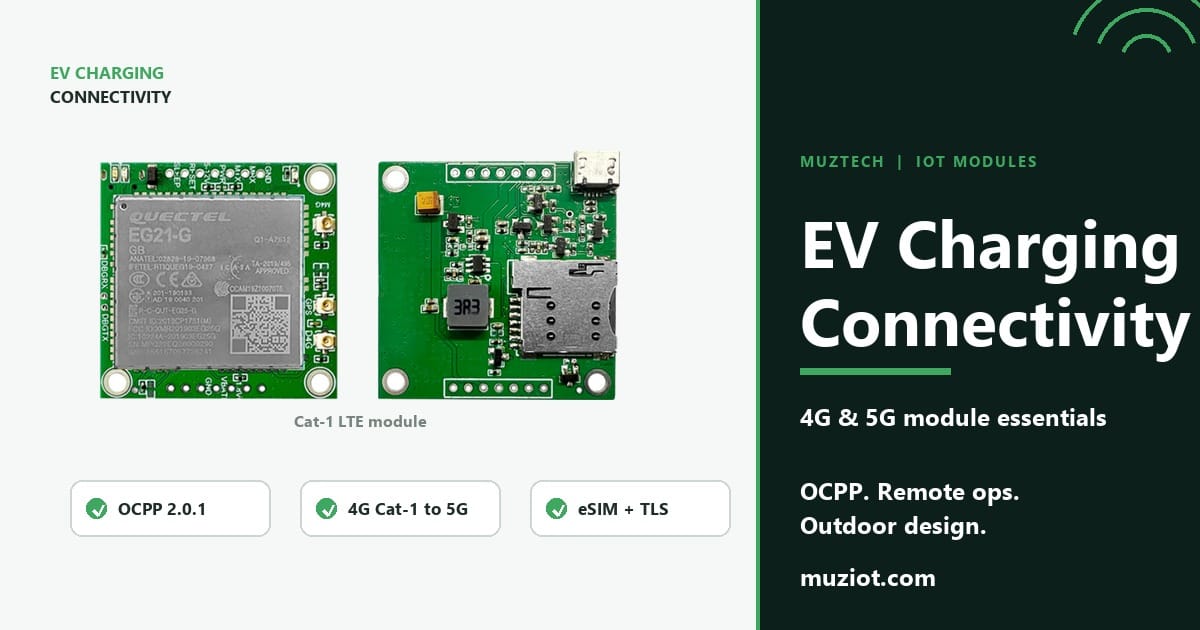
- Cat-1 and Cat-1 bis. Roughly 10 Mbps down and 5 Mbps up is far more than OCPP needs. As the 2G/3G sunset removes the old radio tiers, Cat-1 bis is the cheap, single-antenna upgrade that fits the EG21-G and the SIMCom A7670E. For most stalls, this is the part.
- Cat-4. About 150 Mbps down and 50 Mbps up. Reach for it when the site also runs CCTV, or you want headroom on a hub with many concurrent sessions. The EG25-G, EC25, EG95-E and EM05 are common choices.
- 5G. For ultra-fast hubs, V2G and dynamic load balancing, where low latency and high device density matter. The RG520N and RM520N are real options. Just do not pay a 5G bill on a two-stall car park that reports a meter once a day.
One thing a charger is not: battery-constrained. It is on mains and always on, so you are not fighting peak transmit current in the way a tracker does. Your real constraints are coverage, unit cost, certification, and the box it has to live in.
The band and certification trap
Regional band variants are separate parts, not a single SKU. The part that works in the EU is not the part that works in North America, and North America drags in carrier programs like AT&T Network Ready and Verizon Open Development. Picking a module the vendor has already certified saves you a full round of RF and regulatory work.
A charger carries its own compliance load on top, IEC 61851, UL 2594 and CE depending on the market. Stack an uncertified module on that and you add a second, slower approval cycle to a product that already has enough to prove.
Antenna and the outdoor box
An outdoor charger is a hostile environment. It sits in direct sun, next to power electronics, in rain, snow and dust. A few choices decide whether it lasts.
- Match the antenna to the exact bands and to the enclosure. An external antenna with board-level pigtail beats an internal chip antenna for gain and isolation at a concrete structure.
- Count the radio ports. Higher tiers want 2×2 MIMO, and that means two antennas, not one.
- Watch connector and cable loss. A U.FL to SMA cable run inside a steel cabinet eats signal; keep it short.
- Plan thermal for the enclosure. A module rated for -40 to +85 C means nothing if the cabinet cooks. Size vents, shade and the heat path.
- Protect the module from the mains side. A charger shares a box with switching power electronics, so surge and EFT protection are part of the design, not a nice-to-have.
eSIM for a network, not a single site
Operating hundreds of chargers across markets means you do not want a truck roll every time an operator changes or a contract ends. An eSIM with remote provisioning lets you switch provider and profile without touching the hardware. The eSIM and SGP.32 guide covers the module side. It matters more on a charger than most IoT products, because a charger stays in service for a decade.
That decade is also why lifecycle sits high on the checklist. A module a few quarters from end of life is a redesign waiting to happen. The brand comparison and the module selection guide are the two places to think about roadmap before you lock a part.
Security is part of the spec
A charger is reachable from the public network, and it takes payment. OCPP-J over TLS, certificate management, and the security profiles in OCPP 2.0.1 are not optional extras. If the module stack supports secure boot and trusted storage, take it. A parking lot full of chargers is a far more attractive target than a garage full of dev boards.
The short version
Think stalls, not bits. The cellular decision on a charger is Cat-1 for the ordinary stall, Cat-4 where there is CCTV or a busy hub, and 5G only where latency or density genuinely pays for it. Then match the band variant, keep the antenna outside the steel, and plan the enclosure for sun and surge. Spec it for a ten-year life, and put one eSIM in the design instead of a SIM you will have to swap by hand.
We carry Cat-1, Cat-4 and 5G modules from Quectel and SIMCom, plus antennas and pigtails. Send us the region, the number of stalls, whether the site has Ethernet, and the band requirements, and we will narrow the list.
Sources
- JD Power, “Which countries are leading the global EV charging race?” (https://www.jdpower.com/business/news/which-countries-are-leading-the-global-ev-charging-race/)
- Open Charge Alliance, the OCPP standard (https://openchargealliance.org/)
- Beny, “OCPP 2.0.1 explained: migration tips and costs” (https://www.beny.com/ocpp-201-guide/)
- Telit, “Clearing the road for EV adoption with reliable connectivity” (https://www.telit.com/resources/webinars/clearing-road-ev-adoption-reliable-connectivity/)
- Microchip, OCPP 2.0.1 stack library for Linux (https://www.microchip.com/en-us/tools-resources/reference-designs/ocpp-2-0-stack-library-for-linux)