
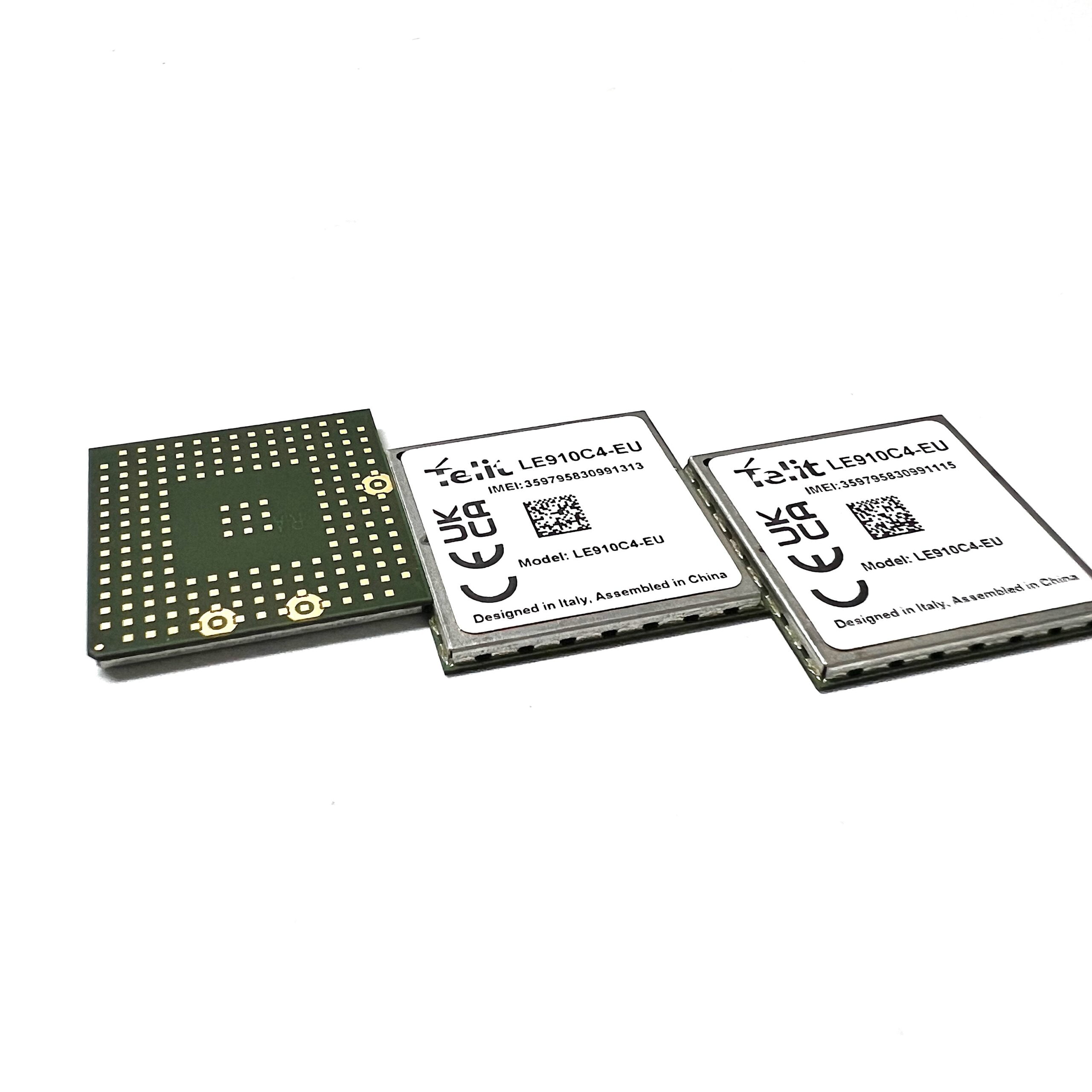
Half of all cellular modules shipped in Q3 2025 were LTE Cat-1 bis. Let that number sit for a second. Half. Every tracker, meter, and wearable that used to run on 2G or 3G is moving to this one chip class, and the migration is nowhere near done.
Meanwhile, 5G RedCap is doing what newcomers do: getting cheaper exactly when you started to ignore it. Module prices are falling from the $30-50 band toward $15-25 by the end of 2026, which puts RedCap inside the same budget territory as the 4G modules it wants to replace.
So the question is not which technology is better. The question is which module belongs in your BOM. This guide gives you the decision framework, the numbers, and the questions to ask before you pick.
The short refresher
Cat-1 bis is a single-antenna 4G chip class with around 10 Mbps downlink. It runs on every LTE network on earth, it is cheap, and the supply chain is boring in the good sense of the word. 5G for IoT: the basics
RedCap is 5G-native, from 3GPP Release 17, with up to 20 MHz of bandwidth and roughly 150 Mbps downlink. eRedCap (Release 18) trims that to 5 MHz for the cheapest tier and should reach devices in 2027. We covered the full background in 5G RedCap Explained, including the coverage caveats. This article is about the choice.
The comparison
| LTE Cat-1 bis | 5G RedCap | eRedCap | LTE Cat-4 | |
|---|---|---|---|---|
| Network generation | 4G LTE | 5G NR (Rel-17) | 5G NR (Rel-18) | 4G LTE |
| Max bandwidth | 20 MHz | 20 MHz | 5 MHz | 20 MHz |
| Typical downlink | ~10 Mbps | ~150 Mbps | ~60 Mbps | ~150 Mbps |
| Antennas | 1 | 1-2 | 1 | 2 |
| Module price trend | Mature, low | $30-50 now, $15-25 by end of 2026 | Expected below RedCap | Mature, similar band to RedCap |
| Network coverage | Worldwide, today | Uneven, growing | Uneven, 2027 and later | Worldwide, today |
| Power draw | Low | Higher | Lower than RedCap | Higher |
| Best fit | Trackers, meters, 2G/3G replacement | Cameras, gateways, EV chargers | Wearables, simple sensors | Routers, in-vehicle, video |
The table is the easy part. The decision actually happens on your product’s timeline, and that is where most teams get it wrong.
If you ship this year, buy Cat-1 bis
If your product ships in the next two or three quarters, Cat-1 bis is the right answer, full stop. The module costs less, the antenna design is a solved problem, and the device will connect to any 4G network it encounters. No carrier acceptance lists to check. No roaming gaps to explain to a customer in a country you have never shipped to.
We sell a lot of Cat-1 bis parts, and the customers who buy them ask one question: does it work with my existing design? It does. That is the entire appeal.
If your product lives until 2030, RedCap earns its keep
The math changes when the lifecycle runs five years or longer. RedCap’s ~150 Mbps opens product categories Cat-1 bis cannot touch: live video, gateways serving several devices, EV chargers that push OCPP traffic and firmware updates over the same link. A Cat-1 charger can update its firmware. Slowly. A RedCap charger does it in minutes, and for a device in the field for a decade, that difference is real money.
The weakness is coverage, and it is not a small weakness. RedCap only works where the operator has turned it on. In 2026 that means major carriers in North America, Europe, and parts of Asia, with the rest of the world somewhere between planning and deployment. If your product ships to forty countries, some of them will give you 4G and nothing else. So a RedCap design today is really a RedCap design with a mandatory LTE fallback. Plan for that from day one and you will be fine. Discover it at certification and you will not.
The hedge: design for both
The professional move is a board that can take either module. Several vendors offer Cat-1 bis and RedCap parts with compatible footprints or shared interfaces, so the choice can be made late and changed without a re-spin.
Ask for the roadmap and the pin-compatibility matrix before you choose. A thirty-minute call with a distributor who carries both is cheaper than a board revision, and it tells you which vendor is actually serious about the transition instead of just printing a roadmap slide.
The cost nobody puts in the spreadsheet
The module price is maybe a third of the story. RedCap carrier certification is still settling, antenna tuning on a new RF front end takes engineering hours, and the power supply needs headroom for a modem that draws more than Cat-1 bis when it transmits. None of that shows up on the module line of your BOM.
We have watched customers save three percent on a module and lose two months in certification. Do not be that customer.
The questions to ask before you commit
- Does the Cat-1 bis module you recommend have a RedCap sibling with the same footprint or interface?
- What is the real price at 1K, 5K, and 10K, not the headline MOQ price?
- Which carriers accept the RedCap module today, and which bands does it cover per region?
- Does the module fall back to LTE on its own, or does the application have to handle it?
- What certifications ship with the module: CE, FCC, IC, or carrier-specific?
- Does the supplier hold stock of both options, so a mid-project switch does not become a twelve-week wait?
The short version
Cat-1 bis wins on price, coverage, and simplicity today. RedCap wins on speed, longevity, and the products you can build with it. Ship this year with a data rate under 10 Mbps and Cat-1 bis is the low-risk pick. Build for 2030 with anything more demanding than telemetry, and RedCap earns the design work, with a solid LTE fallback underneath.
Send us your BOM, or just the two module lines you are deciding between. We carry both, we quote from real stock, and we will tell you honestly which one we would design in for your use case.
Sources
- Counterpoint Research, cellular module shipment data, Q3 2025 (https://counterpointresearch.com/)
- Telecom Review Europe, “5G RedCap to bridge connectivity gaps in mid-tier IoT devices in 2026” (https://www.telecomrevieweurope.com/articles/technology-pick/5g-redcap-to-bridge-connectivity-gaps-in-mid-tier-iot-devices-in-2026/)
- Omdia, “5G RedCap faces adoption challenge while eRedCap shows stronger promise” (https://omdia.tech.informa.com/blogs/2026/july/5g-redcap-faces-adoption-challenge-while-eredcap-shows-stronger-promise)