
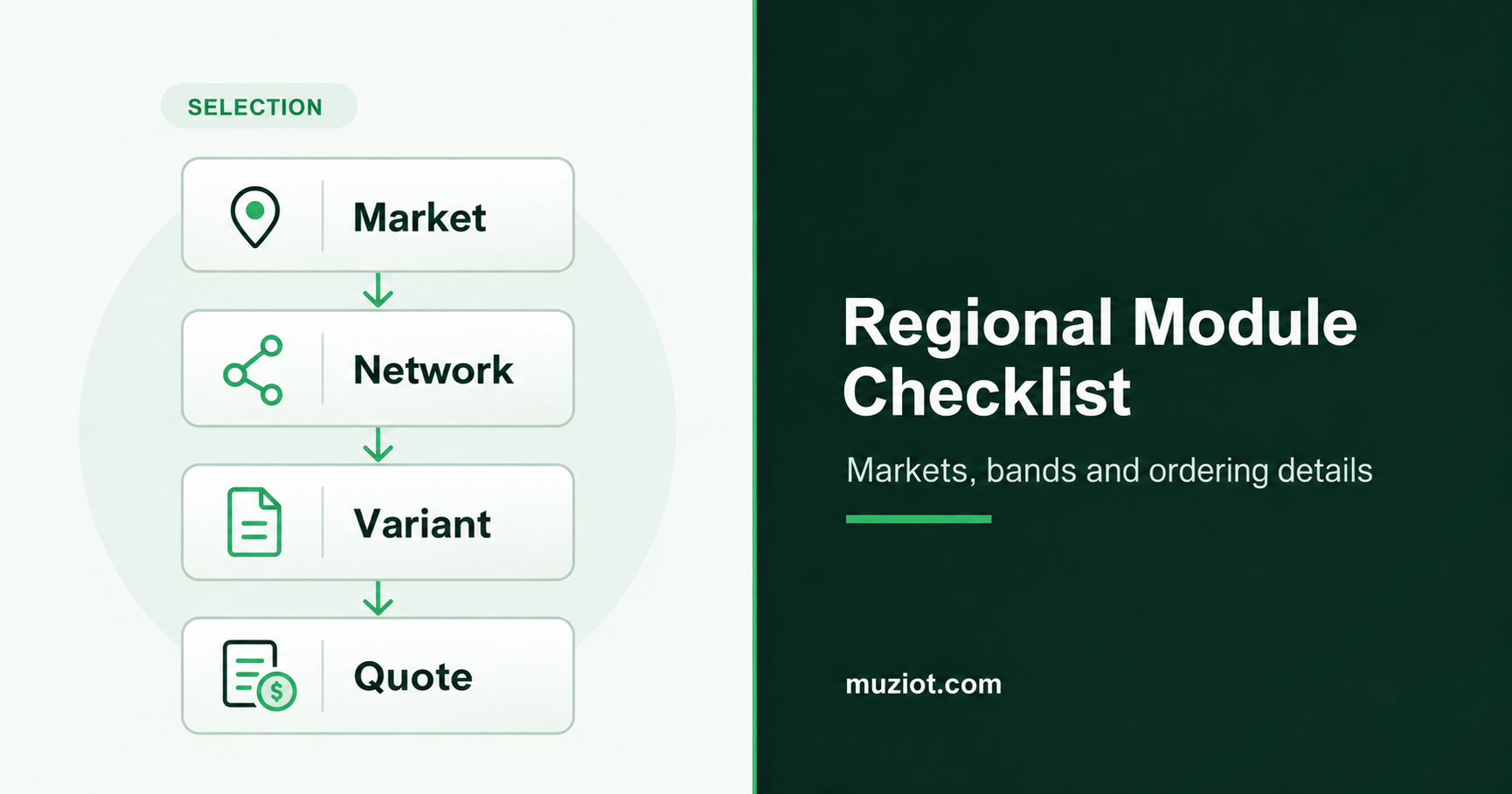
A quotation for a “global cellular module” leaves several purchasing decisions open. Which countries will the device reach? Which operator and service will it use? Which regional variant, firmware and sales form should the supplier quote? Start with those requirements, then compare the exact parts. This turns a family name into a shortlist that engineering and purchasing can use.
Regional suffixes help organize a product range. The useful evidence is the band and network-mode table for the named variant, followed by the operator requirements for the intended deployment. The wider cellular module selection guide covers power, interfaces and performance; this checklist focuses on the regional selection that belongs in a purchase request.
Build a deployment row for each market
Write one row for each country and intended network. Include the installation area: a fixed meter in a basement and a vehicle crossing several countries pose different coverage questions. A country name is a starting point; the operator and service identify what the device needs to connect to.
Record the SIM or connectivity provider beside the radio network. For a roaming service, ask the provider which partner networks and radio technologies the selected plan allows at the destination. A SIM that can register in one market does not settle the requirements for the rest of the route.
Deployment requirements to carry into module selection.
Scroll horizontally to read all columns.
| Requirement | What to record | Who can supply the evidence |
|---|---|---|
| Market and location | Country, installation areas and any cross-border route | Product owner or deployment team |
| Network and service | Operator or private network; LTE, LTE-M, NB-IoT or 5G SA/NSA as required | Operator or connectivity provider |
| RF requirements | Required bands, antenna paths and any network-mode or combination requirements | Network and module technical teams |
| Application functions | Data traffic, voice or SMS requirements, host interface and software needs | Device engineering team |
| Commercial identity | Candidate variant, sales form, quantity and configuration to quote | Buyer and supplier |
For 5G, keep SA and NSA requirements separate when you request a band comparison. Ask for the applicable network configuration and, where relevant, supported band combinations for the intended firmware. A list of individual bands is only one part of that comparison.
Compare the exact regional variant
Keep the manufacturer, family and suffix together in each row. RG520N-EU and RG520N-EB are distinct entries; RG520F belongs on its own specification sheet. Use the RG520N and RG520F product page to reach the separate resources rather than mixing their tables.
Quectel RG520N Specification V1.6, page 2 shows why the suffix and footnotes matter. The following selected differences are useful during a regional review:
RG520N variant differences to retain in a selection record.
Scroll horizontally to read all columns.
| Variant | Documented difference | Selection question |
|---|---|---|
| RG520N-EU / RG520N-EB | EB lists NR n71 and LTE B71; EU does not list those bands. | Does the deployment require either band? |
| RG520N-GT | SA lists n48, n77 and n78; the NSA row has no entry. | Does the planned network use the required SA configuration? |
| RG520N-LA | NR n38 and n71 carry the optional-band footnote. | Does the quoted configuration include the required option? |
Carry the source revision and optional marks into the comparison. For a required optional feature, request confirmation against the proposed ordering configuration before placing the order. Keep the full regional band list in the linked specification beside the purchasing record.
Then match the antenna system to the bands and ports the device will use. The LTE and 5G antenna selection guide covers cables, connectors and installation. A broader module band set can still require changes to the antennas or host design.
Check the operator, firmware and SIM together
Keep LTE B71 and 5G NR n71 as separate entries. T-Mobile’s network guide lists LTE B71 for Extended Range 4G LTE and n71 for Extended Range 5G. A match in one technology does not supply the other.
For an LTE example, SIMCom’s A7672G product table lists a broad set of LTE bands, but B71 is absent. If a US deployment depends on LTE B71 coverage, record that gap and review the candidate with the connectivity provider. Support for other listed operator bands can still matter at the intended sites; the decision needs the deployment requirements, not just the word “global.” The A7672G product page provides the module enquiry and document path.
Once the radio comparison fits, identify the firmware and service requirements. Ask which firmware build supports the intended operator profile, network mode and required functions. Record APN and SIM-plan requirements with the connectivity provider. For voice, request the applicable module and operator voice requirements as a separate item from data access.
Keep approval evidence in a separate column. The PTCRB certification process asks device manufacturers to determine whether additional operator-specific testing is required. Record the exact model, document or listing reference, and whether it covers the module or the finished device; give that record to the project’s compliance owner to plan the next step.
After the document shortlist, check representative deployment sites with the selected module, firmware, SIM and antenna configuration. Record registration, the serving radio technology and bands, data transfers and any required voice behavior. Keep that configuration with the result so engineering can assess a later firmware or component change.
Carry the selected configuration into the purchase request
Use the regional variant name during research. Before purchase, have the supplier identify the complete manufacturer ordering code for the configuration being quoted. Put that code in the purchase line, together with the sales form and agreed firmware or option requirements. A bare LGA module, an M.2 assembly and a development board are different order items.
A useful purchase record connects the deployment requirement to the proposed part and its supporting document. If two manufacturer documents disagree, identify the field, revisions and requested clarification in that record. Resolve the relevant difference before approving the purchase line.
Fields for a regional module purchase record.
Scroll horizontally to read all columns.
| Field | Entry to carry forward |
|---|---|
| Deployment | Countries, locations, operator or private network and SIM provider |
| Radio scope | Required technology, SA/NSA where applicable, bands and combinations to confirm |
| Candidate identity | Manufacturer, family, full regional variant and sales form |
| Quoted item | Complete manufacturer ordering code, quantity, packing and included items |
| Software and options | Agreed firmware, operator profile and required optional functions |
| Evidence | Specification revision, relevant approval references and resolved document differences |
| Change control | Named owner to review a proposed change in suffix, firmware or sales form |
For a second source or a change to an existing board, continue with the cellular module replacement checklist. That review covers pads, power, RF and software changes after a candidate has passed the regional shortlist. It answers a different question from choosing a module for a market.
Send a useful regional module enquiry
You can request a shortlist before you know the final ordering code. Send the intended countries and operators, radio technology, required functions, sales form, host interface and quantity. Include a current module number or proposed family if one is already under consideration. Ask the supplier to return candidate regional variants, the applicable specifications and the configuration to quote.
Use the Datasheet Center to gather the technical references. The BOM preparation guide explains how to carry the selected item into a quotation sheet.
Request a regional module shortlist through the BOM service. Include the deployment rows with the enquiry so the proposed part can be compared against the network and product requirements.
Sources
- Quectel RG520N Series Specification V1.6, page 2: regional variants, radio modes and optional-band footnotes.
- SIMCom A7672G product table: the A7672G column.
- T-Mobile network guide: device compatibility and frequency table.
- PTCRB certification process: device certification and operator-specific testing.