
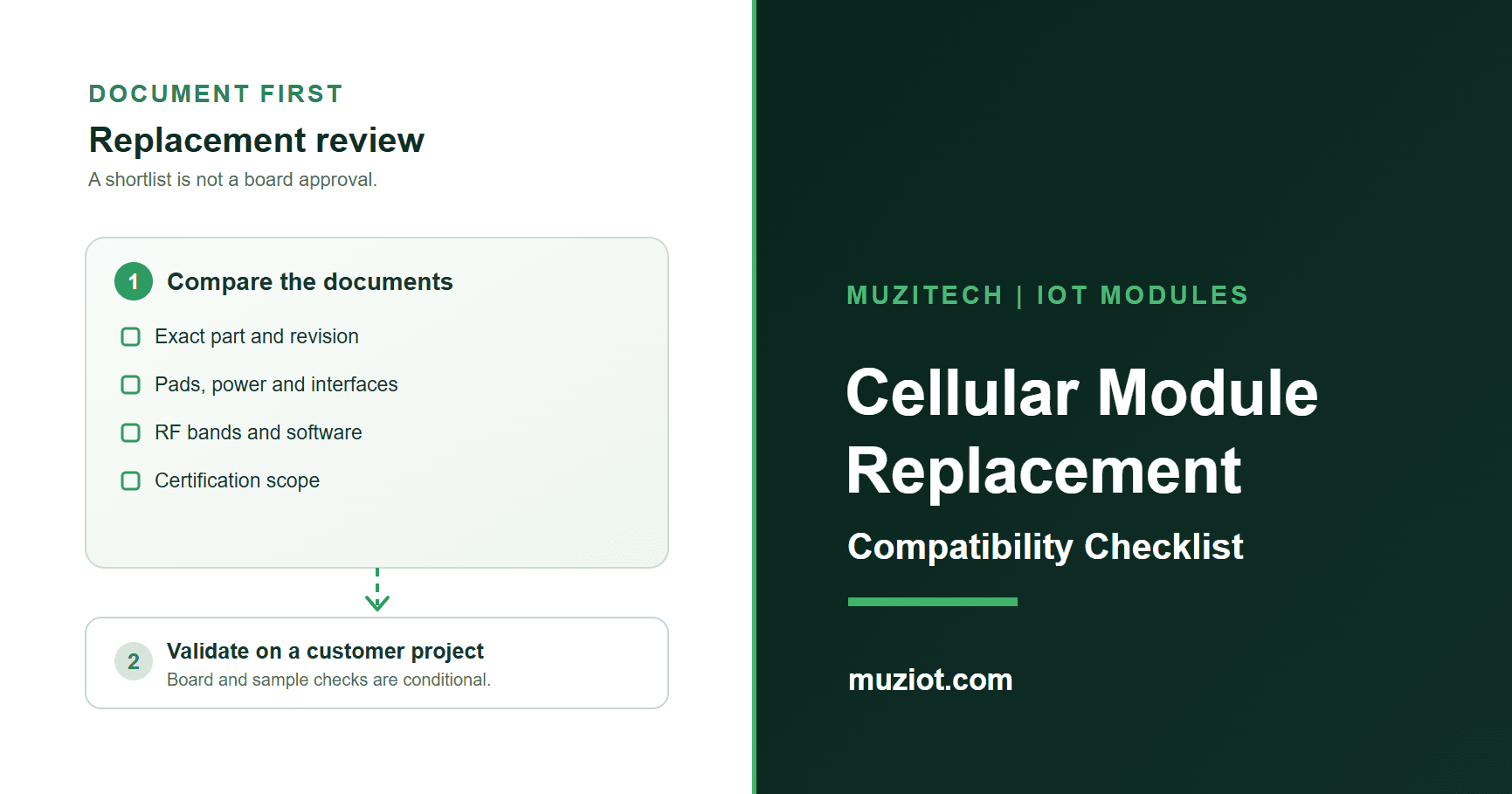
A supplier's "compatible" label can identify a migration path, but it does not approve a replacement on a particular printed circuit board. Start with the documents: identify the exact old and candidate ordering codes, compare the applicable drawings and specifications, and mark each difference an engineer would need to resolve. A purchase decision and a board-level signoff are separate decisions.
This checklist is for a US buyer or hardware team assessing a legacy cellular module, a second source, or a network migration. You can use it before there is an order or prototype plan. Our cellular module selection guide covers the wider module shortlist. If the reason for replacement is a changing network, the 2G/3G sunset migration roadmap helps frame the deployment question; this article screens the hardware and software change.
Define the replacement question
Write down the old module's full ordering code, hardware revision and firmware build if known. Do the same for the candidate. Include the sales form: a bare LCC/LGA module, an M.2 card, a Mini PCIe card and a development board are different purchasing and integration objects. A common family name or matching 24 mm outline is not enough to identify a board-compatible part. Our module form factor guide explains those physical categories.
Record the intended country, network operator or private network, radio modes, and functions that the existing design must retain. These may include a particular UART, USB mode, audio path, SIM interface, sleep behavior, positioning function or firmware update process. For a US deployment, confirm the exact candidate variant and its supported bands against the intended network's current requirements. Do not transfer a band list from another suffix in the same product series.
The output of this step is a question an engineer can answer: "Can candidate part X, revision Y, meet these requirements on board Z after the identified changes?" Without a board and revision, the honest output is a shortlist for review, not a drop-in approval.
Run a document-first comparison
Compare current documents for the exact parts. Record the publication date or revision beside every finding, and put conflicting statements in an open-issues column. A distributor can request a corrected drawing or manufacturer confirmation without having a customer prototype in hand.
| Check | What to compare now | What the document review can conclude |
|---|---|---|
| Identity and supply | Full order codes, suffixes, hardware and firmware revisions, sales form and current offer | Whether the quoted item is the same variant the documents describe |
| Package and pads | Outline, height, pad numbers, ground pads, reserved pins, mounting and solder profile | Whether a detailed board comparison is warranted; equal footprint dimensions do not prove equal nets |
| Power and logic | Supply range, peak-load guidance, startup and shutdown sequence, interface voltage and reset behavior | Whether the old power and logic design raises a documented question |
| RF and network | Exact variant bands, antenna ports, RF routing assumptions, SIM and target operator requirements | Whether the candidate merits network-specific engineering review |
| Software | AT commands, unsolicited responses, drivers, data modes, update path and required features | Which application flows need change or later testing |
| Approvals | Exact certified model, geography, antenna and integration conditions | Which module-level documents to request; no finished-device approval is inferred |
This is an original editorial worksheet. A blank or unclear cell means "ask for evidence," not "passed." The datasheet center is a starting point for available files; the applicable manufacturer revision and the actual ordered variant still need confirmation.
Use SIM800A and A7672G as a screening example
Two SIMCom models show why a family-level compatibility claim needs care. The SIM800A product information describes a 24 x 24 x 3 mm module with 68 SMT pins, a 3.4-4.4 V supply and GSM 900/1800 MHz operation. An archived SIM800A sheet in our records has V1508 in its filename but prints Version 1005 on the page, so its revision needs confirmation. The A7672 Series Specification V2024.09 has a separate A7672G column: 24 x 24 x 2.4 mm, LCC+LGA and 3.4-4.2 V. Similar width and length do not establish pad, voltage, radio or software equivalence. SIM800A's published GSM 900/1800 MHz range does not establish that a legacy SIM800A design operates on a US network; this is a document comparison, not an actual US customer replacement case.
SIMCom's A7672G product page describes a compatible migration path within the series. Its LTE-TDD band list differs from the linked V2024.09 PDF's A7672G column on B34. Ask SIMCom which document and ordering revision governs the offered part before relying on that band. The published generic compatible-design comparison also uses SIM800, SIM800F and A7672X column labels. Those labels alone cannot sign off an exact SIM800A-to-A7672G board.
At this stage, A7672G is a candidate for engineering review against an identified SIM800A design. The documents do not show that a customer can replace SIM800A without a PCB change. See the A7672G module page for the product enquiry path, then request the current exact-part package drawing, pin definitions, hardware guide, AT documentation and certificate scope before choosing a design direction.
Keep physical validation conditional on a customer project
Once a customer decides to pursue a specific replacement, the customer's board owner can compare every used pad with the old schematic, PCB and bill of materials. The project team can then check power behavior, logic levels, RF paths, antenna integration, SIM handling, command and driver behavior, network registration and applicable approvals on the actual host. A change in firmware, enclosure, antenna or carrier board can change what needs to be retested.
Those steps need a board, sample, target network and acceptance criteria. You can make a useful document shortlist or request a quote before any of those exist. Until a project starts, mark physical checks "conditional / not started"; an empty test sheet is not a pass. When the project does exist, assign each test and approval to the customer engineering, module maker or compliance owner who can perform and sign it.
For certifications, separate the module's listed approvals from those of the finished device and its installation. Request the exact certificate number, variant and integration conditions for the intended market. The customer's compliance team determines whether a new evaluation, filing or operator process is required for the final product.
Prepare a useful supplier enquiry
A short, precise enquiry gets a more useful response than "Is it pin compatible?" Send the old and candidate full part numbers, known document and firmware revisions, intended US network, sales form, required interfaces and features, and any known size or power limits. Ask for the latest applicable specifications, package and pin drawings, supported radio variant, software notes, certification scope and current quotation. If no customer board is available, say so; the requested deliverable is a document gap list and a candidate quote.
Muziot's BOM service can help organize that document and sourcing review. Include the exact part numbers and intended application in the enquiry. Any later claim that the replacement works on a particular board must be based on that board's signed engineering and compliance evidence.