
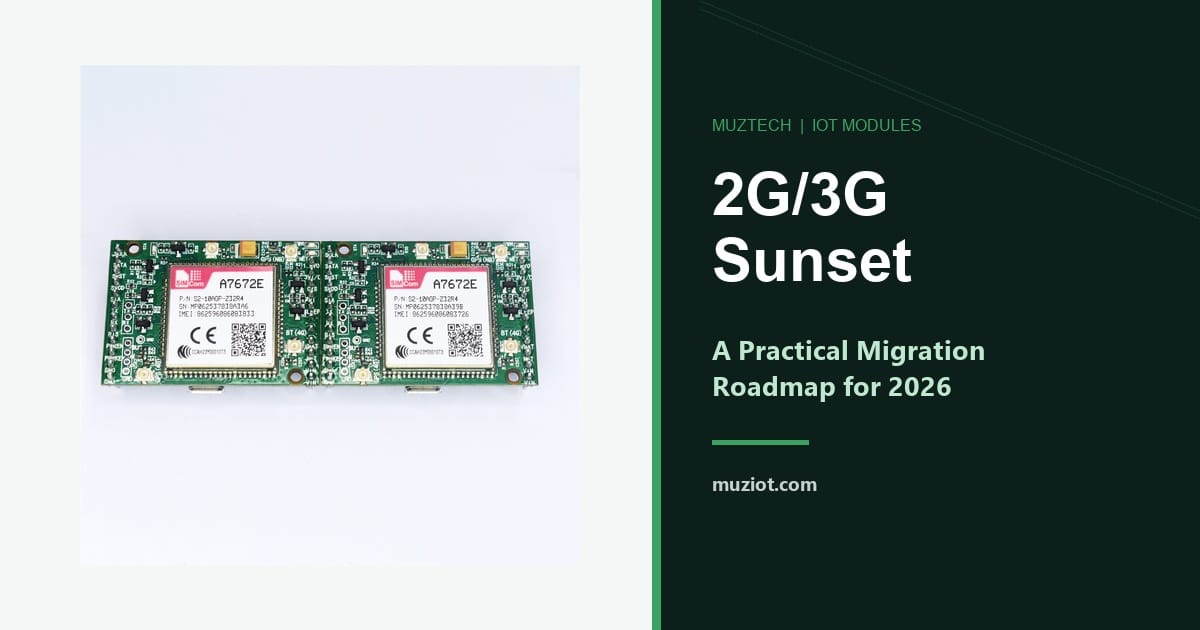
2G/3G Sunset: A Practical Migration Roadmap for 2026
T-Mobile lists August 3, 2026 as the retirement date for its 2G GSM network. A migration plan should use the announcement for the specific operator and service, then confirm the impact on the deployed devices. See T-Mobile network retirement dates.
This is not a 2028 problem. The switch-offs are happening now, market by market.
GSA counted 313 completed or planned 2G and 3G switch-offs by June 2026. A total of 139 operators in 70 markets have retired or scheduled their 2G networks, and 56 of those are already done. The 3G number is bigger: 174 operators in 67 markets, 102 finished. Europe drives 43 percent of the activity, Asia another 26 percent, and 27 operators have killed both networks at once.
The hardware market has already moved. Counterpoint’s full-year 2025 tracker put cellular IoT module shipments up 15 percent year over year, with Cat-1 bis accounting for one of every two modules shipped. Shipment share alone does not determine whether the technology fits a specific migration.
This guide is for the buyer who has not moved yet. It covers the shutdown calendar for the markets you actually ship to, the migration options in order of cost, and the checklist items that quietly eat budgets after the hardware swap.
Operator-specific retirement examples
Sources checked on September 21, 2026. These examples distinguish announced schedules from an operator statement that service has ended. They are not a worldwide coverage guarantee. Confirm the network, service, roaming agreement and installation location for each deployed device.
| Network or market | Verified statement | Scope and source |
|---|---|---|
| T-Mobile, United States | 2G GSM retirement date: August 3, 2026. | Operator-announced date; T-Mobile. |
| United Kingdom | 2G ends by 2033 at the latest; earlier operator schedules apply. | 2033 is not a service guarantee. Ofcom reports EE from May 2029, O2 from summer 2029 and Vodafone during 2030. |
| Orange, mainland France | Further 2G shutdown waves: September 22, October 6 and October 20, 2026. | Earlier regional closures have occurred. Regulatory white zones are an exception, with access ending December 1-15, 2026. Orange calendar. |
| SFR and Bouygues Telecom, mainland France | Arcep lists SFR on November 15, 2026; Bouygues starts in selected cities on November 15, then expands December 1-15, 2026. | Planned dates; recheck the installation address and operator notice. Arcep calendar. |
| NTT DOCOMO, Japan | FOMA 3G service ended March 31, 2026. | DOCOMO completion notice; this row concerns FOMA. |
| China Mobile Hong Kong | Approved 2G cessation date: June 23, 2026. | Hong Kong government approval; approval is not a field test of a device or roaming service. |
For other networks and markets, obtain the current operator schedule before planning a migration. Review voice and emergency-call requirements separately from data connectivity, and do not infer that a country-wide date applies to every provider or roaming arrangement.
When Cat-1 bis may fit a migration
Evaluate LTE Cat-1 bis alongside the alternatives for your fleet. Confirm the destination networks, supported bands, voice requirements, power budget and exact module configuration before choosing a replacement. The choice remains specific to the deployment. Our Cat-1 bis vs RedCap comparison covers the long-term view; the selection still requires a review of the existing hardware, firmware, antenna system and network requirements.
Three cases where Cat-1 bis is the wrong answer:
- Voice matters. A data-only Cat-1 bis module will not rescue a 2G voice product. You need VoLTE, and the module has to support it with the operator’s IMS configuration. Dual-antenna Cat-1 is the safer pick for in-car telematics and other noisy RF environments.
- The device needs real throughput. Video, large firmware pushes, or a gateway role push you toward Cat-4 or 5G, not Cat-1 bis.
- The device is static and battery-critical. A water meter that wakes twice a day is better served by NB-IoT or LTE-M, and our LPWAN guide explains when each wins.
The costs nobody budgets for
The module swap is the visible cost. These are the ones that show up later.
Certification does not transfer. New radio, new CE RED, new FCC filing, and new operator lab entries if the product lives on carrier-managed fleets. Budget the certification run before you pick a module, not after.
Antennas are a second project. A 2G design tuned for 900/1800 MHz will not light up the LTE bands your markets need, often B1/B3/B5/B8/B20/B28 depending on region. The antenna, the matching network and the enclosure all get reworked, and nobody in the field cares that the module is the same size.
Voice has no fallback now. 2G and 3G voice are gone in most markets, so the product either ships with a VoLTE-capable module and the operator’s IMS settings, or it does not make calls. That is a procurement question as much as an RF one.
Field units without OTA update capability must be swapped by hand. Every unit is logistics plus labor, and the older the fleet, the harder the math.
Power is a firmware question. A “Cat-1 bis” module with PSM and eDRX disabled will drain a battery faster than the 2G design it replaces. Ask which low-power modes the firmware actually exposes before you promise a five-year battery.
Supply is tightening. 2G modules are out of production, original stock is narrowing, and refurbished parts carry their own risk. Counterpoint also flags memory shortages and price pressure running into 2026, so lead times deserve more slack than they had last year.
One more layer for multi-country fleets: eSIM and SGP.32 let you switch operators over the air instead of swapping cards in the field, which matters when a migration touches a decade of deployed hardware. Our eSIM and SGP.32 guide walks through what to check on the module itself.
Checklist before you redesign
- Pull the real dates. GSA, Onomondo and KORE all publish operator-level 2G/3G shutdown trackers. Do not rely on a country-level summary for a product that ships to five markets.
- List the LTE bands per market and check them against the module’s region variants. This kills the antenna surprise early.
- Decide the voice path. VoLTE module, operator IMS parameters, and a test call on the target network.
- Confirm low-power modes in the shipped firmware, not the datasheet.
- Scope certification per region, including carrier lab entries.
- Check supply. Original modules, EOL notices, and how many spares you need for the installed base.
- Plan the field. OTA-capable devices update; everything else needs a swap schedule and a budget.
The short version
Build the migration schedule around the operator notices for your deployed locations. Confirm the module variant, firmware, antennas, power budget and voice requirements, then allow time for testing and any required approvals. A distant national deadline is not a commitment that a specific network will remain available until then.
We work with the SIMCOM and Quectel LTE lines every day, including Cat-1 bis and VoLTE-capable Cat-1 parts, and we can check your target markets against the module’s band plan. Send your BOM, or just the module line you are evaluating, and we will tell you what migrates cleanly and what needs a redesign.
Browse all module datasheets in our Datasheet Center.
Related module datasheet
SIMCom A7672E (LTE Cat-1 upgrade): Product · Datasheet PDF
Sources
- GSA, “2G and 3G Switch-Off, August 2026” (https://gsacom.com/paper/2g-and-3g-switch-off-august-2026/)
- Counterpoint Research, “Global Cellular IoT Module Shipments Up 15% YoY in 2025 Driven by 4G Cat-1 bis and 5G” (https://counterpointresearch.com/en/insights/global-cellular-iot-module-shipments-in-2025)
- Android Authority, “T-Mobile sets an official end date for its 2G network” (https://www.androidauthority.com/t-mobile-2g-shutdown-date-3683679)
- Orange Wholesale France, “Shutdown of 2G and 3G technologies in France” (https://wholesale.orange.com/france/en/news/shutdown-of-2g-and-3g-technologies-in-france)
- House of Commons Library, “Switching off 2G and 3G in the UK” (https://commonslibrary.parliament.uk/research-briefings/cbp-9959)
- Onomondo, “2G and 3G sunsets and how to prepare” (https://onomondo.com/blog/2g-3g-sunset)
- JP Smart, “Notice of termination of 3G service” (https://jpsmart.net/blogs/news/important-notice-of-termination-of-3g-service)
- Office of the Communications Authority (Hong Kong), “Communications Authority grants consent to CMHK to cease its 2G services” (https://www.info.gov.hk/gia/general/202512/16/P2025121600336.htm)
- Quectel, “LTE Cat 1 bis modules” (https://www.quectel.com/lte-cat-1-bis-modules)