
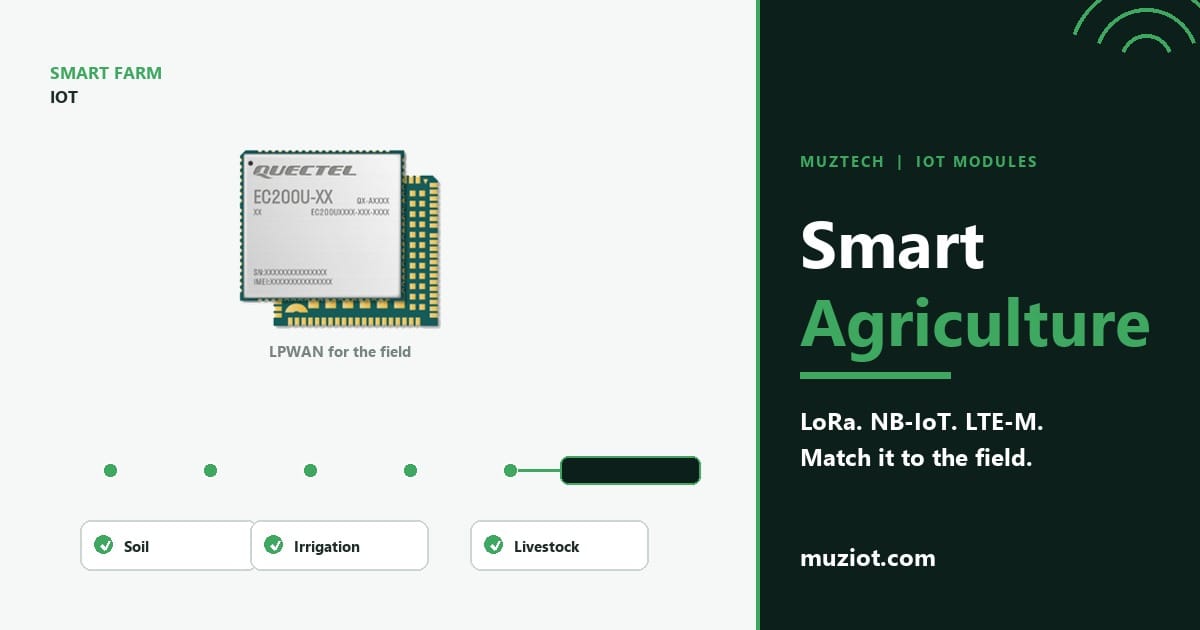
Smart Agriculture Connectivity: LoRa, NB-IoT or LTE-M?
A farm is not one network. A soil probe in the middle of a field, a water meter beside a shed, a grain gate, a pump in a valley, and a tractor that covers forty hectares in an afternoon are five different connectivity problems. The first question is not which LPWAN technology is best. It is which part of the farm you are wiring first, because the right answer changes by location, by data, and by who owns the network.
If you want the raw technology comparison, our earlier piece on NB-IoT vs LTE-M vs LoRaWAN covers bands, battery and cost side by side. What follows is the deployment version: how to match a link to an actual field.
The field is not a fixed sensor
Most of the Internet of Things assumes a node sits still in a place with a known signal. A field breaks that assumption in three ways.
- Coverage is uneven. The tower is three kilometres away, the valley has no line of sight, and the meter box is underground. Deep-indoor and below-grade penetration is exactly where NB-IoT earns its keep.
- Battery life is the whole budget. A soil probe may be serviced once a season. A node that reports daily has to sleep for years, which means PSM and eDRX are not nice-to-haves. They are the product.
- Some nodes move. A tractor, an irrigation pivot, a livestock tag that moves between paddocks, or a grain cart needs a link that follows it. That is where NB-IoT alone can fall short, because it does not handle cell handover well.
The three options and the job each actually fits
NB-IoT for the static, operator-covered sensors. If a cellular operator already covers the ground, NB-IoT is the cost-effective default for fixed sensors and meters. It pushes deep into meter boxes and soil probes, needs a very small radio, and sips power. It is also what the market is actually shipping: NB-IoT accounted for roughly 42 percent of global LPWAN module shipments in 2025, the single largest slice. For a BC92 or BC65 class part, that is a soil-moisture probe, a weather station, a water meter, or a gate sensor.
LoRaWAN for the private, self-owned network. When the farm has little or no operator coverage, or you want to own the network and stop paying per-device SIM fees, LoRaWAN is the fit. LoRa made up about 31 percent of 2025 LPWAN module shipments. You deploy a few gateways per farm and cover long range on your own land, with very low data and multi-year batteries. The trade is that the range, the gateways and the maintenance are yours. That is the right answer for large farmland, high sensor density and a network you control.
LTE-M for the moving or heavier nodes. For something that moves, or needs more than a ping, LTE-M is the cellular choice. It supports the handover a tractor or a moving asset needs, and it carries more data than an NB-IoT slot. It costs a little more per device and per connection, so it is best spent on the parts of the farm that actually produce data, not on every niche.
The cost question a buyer should ask first
This is where a smart-farm build is usually decided, and it is not a module question. If you are deploying many low-data sensors, per-device SIM charges add up faster than the hardware. For a thousand sensors, cellular SIM fees at roughly USD 6 to 18 per device per year can become USD 60,000 to 180,000 over ten years before you count the radios, the installation and the battery service. LoRaWAN moves that cost into gateways you own, which changes the break-even the moment the device count is high and the coverage is poor.
So the honest rule is: low device count and good operator coverage favors cellular NB-IoT; high density, large area or no coverage favors a private LoRaWAN network. Most working farms end up somewhere in between, which is why hybrid builds are the norm.
The hybrid farm is the realistic one
A modern farm rarely runs on a single link. The practical pattern is NB-IoT or LTE-M for the nodes the operator covers well, a private LoRaWAN wherever the coverage is weak or the density is high, and a satellite link for the remote, high-value asset that has neither. The architecture matters as much as the radio: a star of sensors feeding a gateway, with that gateway carrying the uplink, is often simpler and cheaper than trying to make every node reach a tower on its own.
What to check on a datasheet for the field
Before you pick a part, pull the datasheet and verify four things that decide whether a farm sensor lives or dies.
- Band plan matches the operator. The bands you need are the bands the carrier in your region actually runs. A module that is a different regional variant is a different product.
- PSM/eDRX and sleep current. Years on a battery live or die here. Ask for the real sleep current and the supported power-saving modes, and size the battery against the reporting cadence, not the datasheet headline.
- Certification for your market. CE/RED in Europe, FCC and the relevant local approvals where you sell. A farm sensor installed across a state is not the place to find out a module was never approved.
- GNSS if you need position. For tractors, irrigation pivots and precision work, pair the radio with a good GNSS receiver like the L76.
Our module selection guide covers these checks in more depth.
What we keep in stock
We carry NB-IoT, LTE-M, LoRa-capable and Cat-1 modules from Quectel and SIMCom, plus GNSS receivers and antennas, and we hold stock rather than quoting from a list. For a static field sensor, look at the BC92 or BC65; for a moving tractor or gateway, the BG95; and for a gateway that uplinks more data, the EG21-G. Browse the Quectel range and pull a datasheet for the band plan and PSM specs.
The short version
A farm is not one network, so do not pick one technology for the whole thing. Use NB-IoT for static, operator-covered sensors; LoRaWAN for a private network on large or poorly covered land; and LTE-M for the moving or heavier nodes. Count the SIM cost before the module cost, and prefer the hybrid build most real farms end up on. Match the radio to the field, not to the catalog.
Tell us what you are wiring and the quantity, and we will pull the stock list, the band plan and a realistic ship date. Then send us your BOM and we will do the same for the whole line.
Sources
- inwwin, “Global and China LPWAN communication module market analysis (2026)” (https://m.inwwin.com.cn/77/view-1178721-1.html)
- Research Nester, “Narrowband IoT market size and share, 2035 forecast” (https://www.researchnester.com/tw/reports/narrowband-internet-of-things-nb-iot-technology-market/2925)
- Langlide, “LoRaWAN vs cellular for smart farms: range and TCO” (https://langlide.com/knowledge/lorawan-vs-cellular-for-smart-farm-deployments-connectivity-range-and-tco-comparison)
- IET Wireless Sensor Systems, “Smart agriculture through IoT and machine learning” (https://digital-library.theiet.org/doi/full/10.1049/wss2.70033)
- Quectel, “How to choose the best module for smart farming” (https://www.quectel.com/blog/choose-best-module-for-smart-farming-intelligent-agriculture/)