
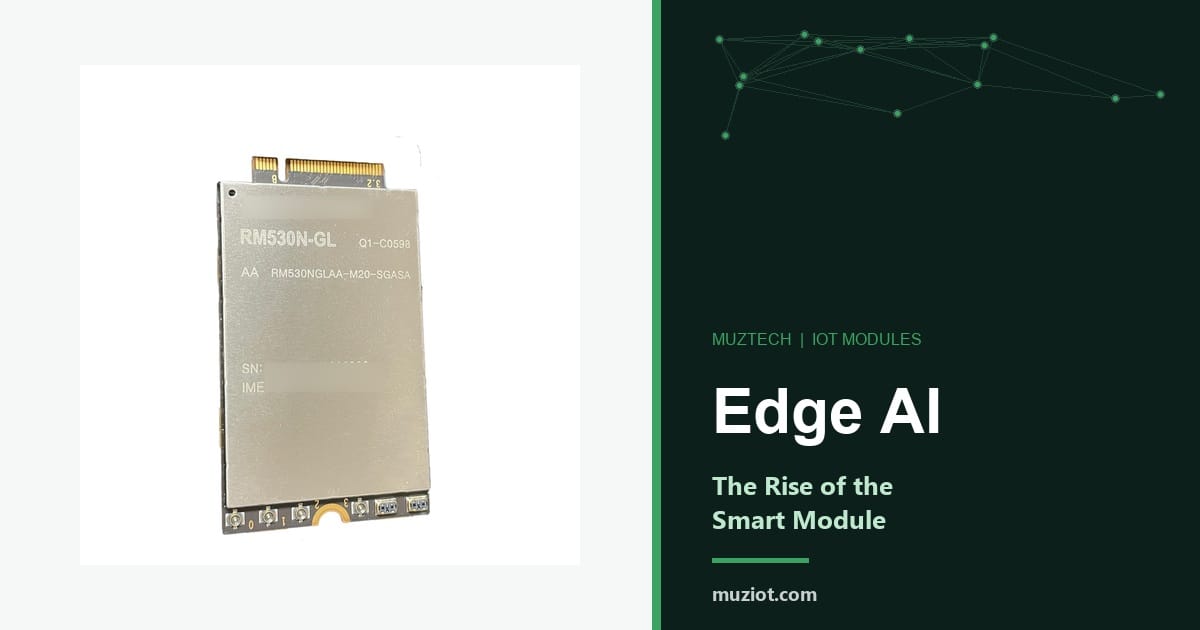
Edge AI Meets Cellular Modules: The Rise of the Smart Module
A camera on a factory line spots a defect it was never explicitly programmed to look for. It does not ask the cloud first. It decides on the module, in milliseconds, and sends one short alert instead of streaming video for a human to review.
That is the difference a smart module makes, and 2026 is the year the hardware market started treating it as normal.
IoT Analytics counted smart modules at 2 percent of global cellular IoT module shipments in 2023 and forecasts 10 percent by 2027, a 79 percent CAGR. AI-enabled modules follow the same curve: from 2 percent to 9 percent, a 73 percent CAGR. Most modules that ship today are still the plain kind, the ones that move bytes and think nothing. The direction is not in doubt.
This guide covers what a smart module actually is, the three capability tiers you will see in datasheets, and the design questions to answer before you put one on your board.
Three kinds of module, one confusing label
The term "smart module" gets used for two different products. The difference matters at procurement time.
A smart cellular module adds a real application processor on top of the modem. It runs Android or Linux, drives a display and a camera, and does the job that used to need a separate application board. The Quectel SG865W line is a familiar example: a Kryo 585 CPU, Wi-Fi 6, Bluetooth 5.1, and rich multimedia interfaces in one package. The Cavli CQS290 is another, an Android module aimed at POS and gateway designs.
An AI-enabled module goes further and adds a dedicated NPU or tensor processor for inference. It does not just run software; it runs models. In 2023, AI-enabled modules were still rare enough that IoT Analytics could count the whole category at 2 percent of shipments. By 2027 the same tracker expects 9 percent.
The honest way to read these labels: smart means the module can compute, AI-enabled means the module can infer. If a datasheet says "edge AI" without naming a TOPS figure or an NPU, treat it as marketing until the chipset confirms it.
The three TOPS tiers
TOPS, trillion operations per second, is the standard shorthand for AI compute. IoT Analytics splits AI-enabled modules into three bands, and the split is useful because it lines up with real applications.
Low capability, under 5 TOPS, made up 59 percent of AI-enabled module shipments in 2023. These modules handle simple vision, voice triggers and access control. The Fibocom SC138-EAU with its Qualcomm QCM6125 sits in this band.
Medium capability, 5 to 10 TOPS, was 36 percent of shipments and is the fastest growing middle. This is the band for defect detection, human-machine interaction and smarter POS terminals. Quectel’s SG-530C-CN, built around the UNISOC P778 with an 8 TOPS NPU, is a representative part. Shipments here grow at a projected 102 percent CAGR through 2027.
High capability, over 10 TOPS, was only 5 percent of shipments in 2023 but grows at a projected 128 percent CAGR. Predictive maintenance and driver safety systems live in this band, with parts like the MeiG SRM930 running Qualcomm’s QCM6490 and its sixth-gen AI engine.
TOPS is not the only number that matters. Memory, power draw and the toolchain around the NPU decide whether a model actually runs well. Two modules with the same TOPS figure can ship very different real-world performance. Ask which runtime is supported, ONNX, TensorFlow Lite or the vendor SDK, before you compare prices.
What changed in 2026
Three things moved this year, and together they turned edge AI from a talking point into a procurement category.
First, MWC Barcelona ran on the "IQ Era" theme. Pegatron put the shift in one sentence: connectivity is no longer the end goal, but the foundation for pervasive intelligence. MicroEJ came back from the show writing about agentic AI at the edge, and Omdia’s MWC wrap-up described the dawn of AI intelligent networks. The direction was consistent across vendors that normally disagree about everything.
Second, IoT Analytics called 2026 the first broad wave of IoT devices with embedded edge AI acceleration, with AI-enabled chipsets expanding into sensors, connectivity modules and industrial PCs. OEMs, the firm argues, are moving from 2025 pilots to full portfolio refreshes marketed as edge-AI products. That is the same signal as the shipment forecast, just earlier in the cycle.
Third, the hardware got more accessible. Quectel launched the FCM665D in late July 2026, a Wi-Fi 6 and Bluetooth module with edge AI aimed at smart lighting and central control hubs, not just industrial gateways. At the high end, Qualcomm’s Dragonwing IQ10 family pushes toward 700 TOPS for robotics, which matters less for a typical IoT product than for what it says about where compute is going: the ceiling keeps rising while the floor gets cheaper.
What it means for your BOM and your schedule
Putting a smart module on the board changes the product plan, not just the parts list. how to build a BOM & get accurate quotes
The BOM gets shorter. One module replaces the modem, the application processor, the memory and sometimes the display driver. The unit cost is higher, but the board is simpler and the supply chain has fewer vendors to juggle.
The software stack decides the team. Android modules bring a familiar app ecosystem and a heavier footprint. Linux modules give you more control and less baggage but require embedded Linux skills on staff. Pick the stack before the module, not after.
Power and thermals need a plan. An NPU doing inference draws current in bursts, and a module that runs Android does not fit the PSM/eDRX story you used for an NB-IoT sensor. Budget for active cooling or duty-cycled inference, and measure real workloads early.
Certification is the same slog, with one extra layer. CE and FCC runs do not shrink because the module is smart, and carrier approvals get more complex when the device runs an operating system. Start the certification conversation when you shortlist the module.
Security becomes a design requirement. A smart endpoint is a bigger attack surface than a dumb sensor, and regulation is catching up. IoT Analytics lists security-by-design among its 2026 semiconductor predictions, pointing at the EU Cyber Resilience Act. Plan OTA updates, secure boot and a software bill of materials from day one, not after a field incident.
When to skip the smart module
Not every product needs one. A water meter that reports once a day does not benefit from an NPU; it needs NB-IoT or LTE-M and a battery that lasts a decade, and our LPWAN guide explains that tradeoff. A tracker that sends coordinates every hour does not need local inference either.
The dividing line is judgment. If the device must look at something, listen to something, or respond to a human in real time, a smart module earns its cost. If it just reports numbers, it does not.
And if your product does need real throughput on top of local compute, the 5G options matter, which is where RedCap enters the picture: the mid-tier 5G class that fits cameras, gateways and industrial devices better than full 5G.
The short version
Smart modules were 2 percent of the market two years ago and are heading to 10 percent by 2027. MWC 2026 gave the category a name, IoT Analytics gave it a timeline, and vendors from Quectel to Qualcomm gave it cheaper hardware. The question for a product team is no longer whether edge AI will matter, it is which tier of module fits the product and when to start the design.
We stock SIMCOM, Quectel and Fibocom LTE and 5G modules, including the smart and AI-enabled lines, and we can help you match compute, connectivity and cost against your real workload. Send your BOM, or describe the device you are planning, and we will tell you which tier to evaluate.
Browse all module datasheets in our Datasheet Center.
Related module datasheet
Quectel RM520N-GL (5G Sub-6, M.2): Product · Datasheet PDF
Sources
- IoT Analytics, "The rise of smart and AI-capable cellular IoT modules" (https://iot-analytics.com/rise-of-smart-ai-capable-cellular-iot-modules)
- IoT Analytics, "6 IoT semiconductor predictions for 2026" (https://iot-analytics.com/iot-semiconductor-predictions)
- Pegatron, "Pegatron 5G to Redefine the IQ Era at MWC 2026" (https://www.prnewswire.com/news-releases/pegatron-5g-to-redefine-the-iq-era-at-mwc-2026-unveiling-ai-driven-connectivity-and-edge-intelligence-302696609.html)
- MicroEJ, "Back from MWC 2026: Agentic AI at the Edge Driving the IQ Era" (https://www.microej.com/news/back-from-mwc-2026-agentic-ai-at-the-edge-driving-the-iq-era)
- Omdia, "IoT at MWC 2026: The IQ Era heralds the dawn of AI intelligent networks" (https://omdia.tech.informa.com/om143608/iot-at-mwc-2026-the-iq-era-heralds-the-dawn-of-ai-intelligent-networks)
- Quectel, "Quectel launches high-performance FCM665D module for edge AI applications" (https://www.quectel.com/news-and-pr/high-performance-wi-fi-6-module-edge-ai-fcm665d)
- Quectel, "Wi-Fi & BT SG865W smart module series" (https://www.quectel.com/product/wi-fi-bluetooth-sg865w-wf-smart-module)
- Qualcomm, "Dragonwing IQ10 Series" (https://www.qualcomm.com/internet-of-things/products/iq10-series)