
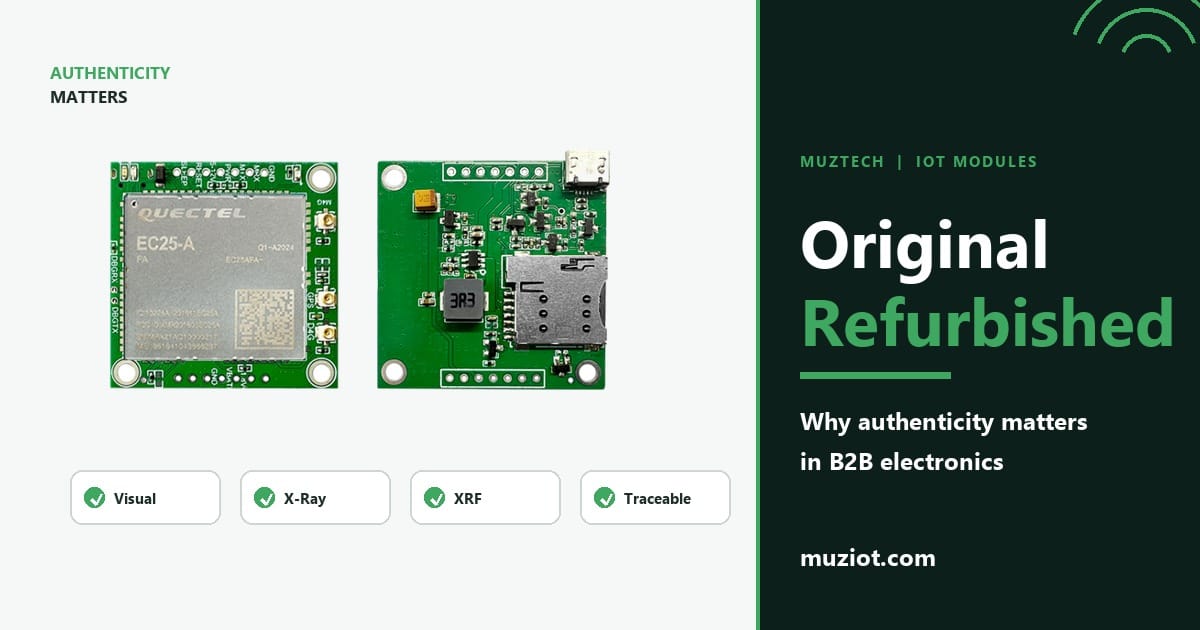
Original vs Refurbished Components: Why Authenticity Matters in B2B Electronics
A component that is a little cheaper is never just a little cheaper. It is cheaper somewhere you cannot see, and it will bill you later, in rework, field returns, a warranty line, and a customer who does not come back. That is the real price of a part that was pulled off a scrapped board and sold as new.
Two words that get blurred
Original and refurbished are not minor variations of each other. An original part is factory-fresh, straight from the manufacturer’s production chain, with a traceable lot and date code. A refurbished part has a history. It was soldered, run, removed, cleaned, and usually re-marked before it reaches you.
Refurbished is not automatically bad. Used parts can be a legitimately cheap option for a prototype or a repair, but only when the seller says so and tests and documents it. The problem starts when a recovered part is sold as new, or when a topmark is scrubbed and reprinted to hide the age. That is not refurbishment. That is counterfeit.
What a non-original part does to your line
A part with a solder-and-remove history carries its previous life with it. The leads may have been re-tinned and the plating is thinner. A joint that was reflowed once cracks at the second reflow. Cleaning and handling add moisture and ESD exposure. Most of that never shows on a bench test.
The harder problem is re-marking, often called blacktopping. Old or recycled stock gets a fresh date code and a clean-looking laser so a 2016 batch reads as a 2024 one. It looks right in a photo and in a tracking sheet. It fails on a real line, at volume, after the board is built.
Electrical testing will not catch the bulk of it. Units that pass a simple continuity or functional bench check can still be the wrong silicon, a different grade, a re-marked die, or a part that was already heat-cycled. Screening has to go beyond the multimeter.
The bill is not a unit price
The savings are a fraction of a dollar. The exposure is an entire batch. One bad lot means a board respin, a line stop, a field call, lost uptime, and in a regulated product, the wasted hours proving where a part came from. For an electronics seller, a single counterfeit incident costs more than a year of buying the genuine part.
Counterfeit and nonconforming electronic parts carry industry-wide estimates in the billions of dollars a year. When supply tightens and lead times stretch, buyers drift toward unvetted sources, and that is exactly when the cheap part shows up with a nice photo and no history.
The gray market does not appear at random. It appears where a part is hard to get: a long lead time, a part near end of life, an allocation you cannot fill. That is when the broker bin starts to look like the only option, which is where the re-marked stock tends to live. The risk is not the ordinary part you buy every week. It is the part you are already struggling to source.
How authenticity is actually verified
There is no single magic test. There is a stack of checks, and the good suppliers run more than one.
- Source first. Buying from the manufacturer chain, or from a distributor that buys there, is the single biggest lever. The avoidance standards point at this first.
- Marking and package inspection. Logo, fonts, date and lot codes, mold flash, package style. A wrong font, a laser that looks re-run, a mismatch between the part and the tray, all of it is a flag.
- Topmark and solvent check. Wipe a re-printed topmark with solvent. If it lifts, it was not applied at the factory.
- X-ray inspection. Look at the internals. The die, the wire bonds, the lead frame. A different package or the wrong die does not match the datasheet.
- XRF and elemental analysis. Does the lead-free alloy match the original? An elemental mismatch is a strong sign of a remark.
- Electrical test. Necessary, and never sufficient on its own. Suspect parts pass it more often than anyone would like.
- Traceability. Can you show the lot, the date code, and the path back to the factory? If the answer is “it came from a bin,” that is the answer.
An original part also travels with its original packaging. A sealed anti-static reel, the factory tube or tray, a label that matches the lot and date code. When a supposedly new part shows up loose in a bag with no label at all, the origin story is already thin. Packaging is not proof on its own, but its absence is worth asking about.
Two standards matter if you buy from a distributor. SAE AS6081 sets the counterfeiting-avoidance protocol for independent distributors, and SAE AS5553 covers avoidance, detection and mitigation more broadly. A supplier that screens to those practices is a different animal from one that forwards a photo and calls it done.
The questions that do the work
Before you commit a BOM to a vendor, ask these and get the answers in writing.
- Is this original, refurbished, or recovered? State it plainly.
- Do you test every part, or sample a batch?
- Which tests? Visual, marking, X-ray, XRF, electrical?
- Can you share the lot and date code and a certificate of conformance?
- Where did the parts come from, an authorized chain or a broker?
- What is the warranty, and what happens when a part fails in the field?
The vendor that answers all six honestly, and with documents, is the one you can build on. The vendor that answers three and goes quiet is the risk.
The cheap part costs more
Save half a percent on the unit price and you can lose far more than that on the first failed field return. Buy original from a source you can trace, keep the paperwork, and treat a vague answer as a red flag, not a negotiation.
We supply modules and components and screen them before they ship, with inspection and warranty behind the order. See how we work on our about page, browse the Quectel range and the SIMCom line, and start with a clean BOM and a supplier you can trace.
Sources
- ERAI, “ERAI 2025 annual report” (https://www.erai.com/erai_blog/3192/Damir_Akhoundov__2025_Annual_Report)
- ANAB, “What is AS6081?” (https://blog.ansi.org/anab/what-is-as6081/)
- Altium / Octopart, “How counterfeit parts are made and misrepresented” (https://resources.altium.com/p/octopart-edge-how-counterfeit-parts-are-made-and-misrepresented)
- IBS Electronics, “How to identify counterfeit components and mitigate risk” (https://www.ibselectronics.hk/resources/blog/how-to-identify-counterfeit-components-and-mitigate-risk/)
- Dalbani, “The risks of gray market electronic components” (https://dalbani.com/blog/risks-of-gray-market-electronic-components/)
- Astute Group, “Active component counterfeits raise sourcing risks for OEMs” (https://www.astutegroup.com/news/general/active-component-counterfeits-raise-sourcing-risks-for-oems/)