
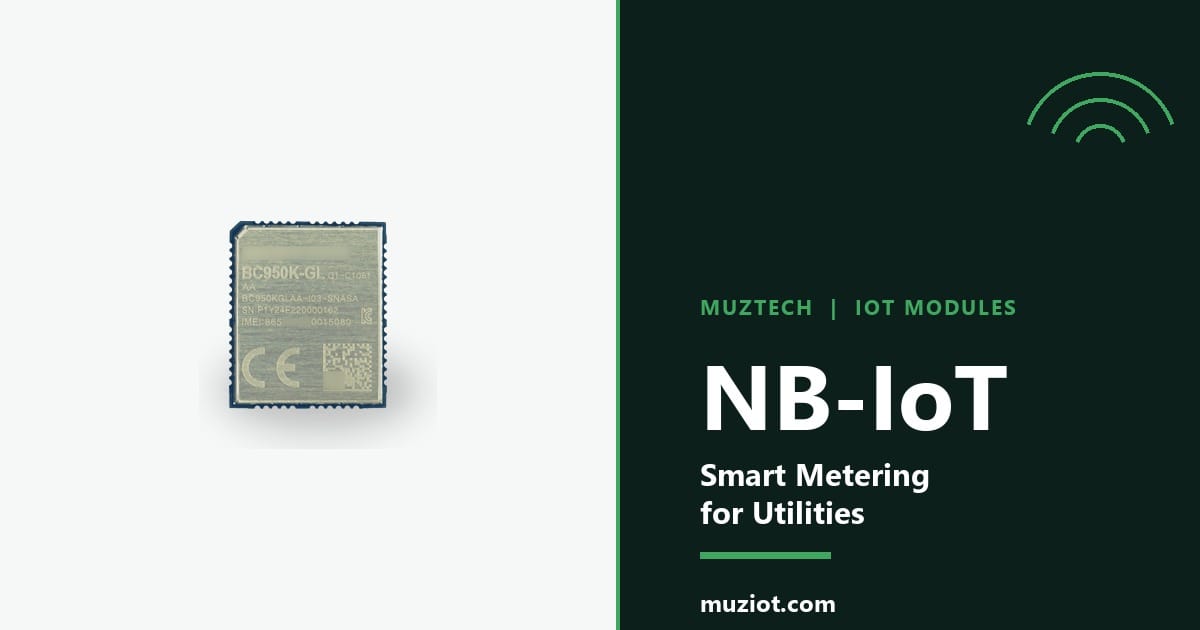
NB-IoT and Smart Metering: Why Utilities Standardize on Cellular LPWAN
A smart meter sits in a basement behind concrete, inside a metal cabinet, with a battery nobody wants to swap for ten years, and it has to report on time. Every part of that sentence is a problem for a radio. The meter is the worst location in the building, the device never moves, and the maintenance budget is zero after installation.
That is why smart metering became the largest and most reliable low-power wide-area (LPWAN) category, and why most of it now runs on NB-IoT.
The meter is the hardest location in the building
Meters rarely sit next to a window. They live in basements, cellar corridors, meter rooms, underground vaults, and steel submetering cabinets. The enclosure is often metal. There is no power grid at the device beyond a small lithium pack or a coin cell. And once the meter is in the wall, no one wants to return for a decade.
The communication requirements are small but unforgiving. A meter sends a few hundred encrypted bytes once or twice a day. It does not need bandwidth. It needs three things: coverage that reaches the worst corner of a building, a battery that lasts the life of the meter, and hardware and connectivity the utility does not have to build and maintain.
Where NB-IoT wins
NB-IoT was designed for exactly this case. It delivers up to 20 dB more link budget than conventional LTE or GPRS, which is the difference between a meter that reports and one that stays dark behind three walls. Power saving mode and extended DRX let the module sleep for long stretches and wake on a schedule, which is how a battery meter reaches ten years or more on small cells. Module prices are below USD 5 at volume, and a single base station can hold hundreds of thousands of connections.
The important structural advantage is that the utility does not run a network. NB-IoT rides licensed spectrum on infrastructure the operator already owns, so there are no gateways to mount, no RF surveys to fund, and no mesh to maintain. Field trials in Brazil found NB-IoT reaching basements and meter rooms 22 percentage points better than legacy mesh, measured against the exact failure mode that matters.
Battery design follows the protocol. With eDRX, some utilities wake a meter every 30 minutes instead of every few hours, and operators still project a battery life of up to 20 years under the right conditions. The point is that a decade-long meter is a firmware and sleep-cadence decision as much as a bill-of-materials one.
The market is already at scale
This is not a pilot story.
Europe is the reference. Around 127 million smart electricity meters are forecast to be deployed in the region between 2023 and 2029, taking the installed base to roughly 335 million. France finished the mass phase of its nationwide rollout in 2022. Germany set a legal target of equipping 95 percent of mandatory installation cases with an intelligent metering system by 2030, stepping through 20 percent by 2025 and 50 percent by 2028. The United Kingdom aimed to reach 80 percent of homes and 73 percent of small businesses.
North America is further along on electricity but growing on water. Smart electricity meter penetration reached 82 percent in 2024 and is forecast to grow at 2.9 percent a year to 180.9 million units by 2030. Water AMI endpoints in Europe and North America are set to double between 2024 and 2030, reaching around 139.5 million endpoints at a 13.3 percent compound rate.
At the network level, Omdia forecasts cellular IoT connections rising from 4.3 billion in 2026 to 5.9 billion by 2035, with NB-IoT, LTE-M and eRedCap together making up roughly 65 percent of that base. Cellular LPWAN is already taking a growing share of AMI shipments alongside LoRaWAN, because it removes the gateway and the radio network buildout.
NB-IoT versus the alternatives
- LTE-M: higher throughput, better roaming, and support for more frequent reads or firmware updates. It costs a little more and draws a little more power. Choose it when a meter needs more than a couple of reads a day, or when a single module has to work across operators that only run LTE-M.
- LoRaWAN: no per-SIM data cost and no cellular footprint, but the utility builds, owns and maintains the gateways, and coverage is only as good as its own network.
- PLC and mesh: already common in electricity metering, but they struggle across substations, transformers and building boundaries, and still need a backhaul.
For the classic battery meter in a basement, NB-IoT is usually the simplest answer, especially when the operator already covers the region.
The checklist before you design
- Power budget: define capacity, cell chemistry and a sleep cadence, then model it in power saving mode and eDRX. Confirm the eDRX values the operator actually configures before you promise a decade of battery.
- Single or dual mode: the BC92 is NB-IoT plus GSM for regions still leaning on 2G, but GSM is being retired, so a pure NB-IoT module is cheaper where it is safe. Consider an LTE-M and NB-IoT multi-mode module if you ship into many operators.
- Metering protocol: electricity runs on DLMS/COSEM, while heat and water often use M-Bus. The application layer sits on top of the radio, so make sure the module and stack handle the encryption and the daily read window.
- Antenna: a metal enclosure needs a clear aperture, a cut-out or an external stub. Test in a real meter cabinet, not on a bench, because the +20 dB figure is an average and every building is different.
- SIM and eSIM: for multi-operator or multi-country fleets, an eSIM with remote provisioning avoids touching hardware. Our eSIM guide covers what to check.
- Coverage survey: run a deep-indoor survey in the actual basements before you commit to a design. One bad cellar can invalidate a rollout.
- Band set and certification: verify the band set matches the target markets and that the module is certified where it will be deployed.
When NB-IoT is the wrong answer
If the meter needs sub-minute reads, real-time demand-response switching or high-frequency data, LTE-M or a wired and PLC path is the better fit. If the utility already runs a nationwide LoRaWAN and wants no per-SIM cost, staying on LoRaWAN is reasonable. And if the site has Ethernet or fiber, do not use cellular at all. The LPWAN guide walks through the tradeoffs in more detail.
The short version
Smart metering is the biggest and most reliable LPWAN category because the device is always in the worst radio spot and never moves. NB-IoT is built for that exact case: better link budget, longer battery, cheaper module, no gateways. The installed base is already large, and the cellular share of metering is only rising. If your next product is a meter, or the connectivity inside one, the module decision starts with NB-IoT.
We stock the Quectel and SIMCom cellular lines, including the NB-IoT and GSM dual-mode BC92 and SIMCom NB-IoT modules. We can match bands, power profile and dual-mode fallback against your target markets. Send your BOM, or describe the meter you are building, and we will tell you which module to evaluate.
Browse all module datasheets in our Datasheet Center.
Related module datasheet
Quectel BG96 (LTE Cat M1 / NB1): Product · Datasheet Center
Sources
- Omdia (via Telecoms.com), “Omdia sees cellular IoT growth shift towards eRedCap dominance” (https://btw.media/en/omdia-sees-cellular-iot-growth-shift-towards-eredcap-dominance)
- Berg Insight (via Smart Water Magazine), “Water AMI endpoints in Europe and North America to double by 2030” (https://smartwatermagazine.com/news/berg-insight/number-water-ami-endpoints-europe-and-north-america-double-next-6-years)
- Berg Insight (via IoT M2M Council), “Smart meter penetration in North America hits 82 percent” (https://iotm2mcouncil.org/iot-library/news/smart-energy-news/us-smart-meter-penetration-to-top-90-by-2030/)
- Research and Markets, “Smart Electricity Meter – Market Share Analysis, Industry Trends and Growth Forecasts (2026-2031)” (https://www.researchandmarkets.com/reports/5239292/smart-electricity-meter-market-share-analysis)
- LP Information, “Global NB-IoT Smart Water Meter Market Growth 2026-2032” (https://www.marketresearch.com/LP-Information-Inc-v4134/Global-NB-IoT-Smart-Water-44928591/)
- STMicroelectronics, “NB-IoT technology” (https://www.st.com/content/st_com/en/support/learning/essentials-and-insights/connectivity/nb-iot/nb-iot-technology.html)
- Vodafone IoT, “How cellular LPWA enables the massification of IoT” (https://iot.vodafone.com/news-and-insights/how-cellular-lpwa-enables-the-massification-of-iot)
- Quectel, “LPWA BC92 NB-IoT/GSM” (https://www.quectel.com/product/lpwa-bc92-nb-iot-gsm/)
- corrently, “Smart Meter Rollout: Status Quo und Zielerreichung 2030” (https://corrently.io/books/flexibilisierung-der-stromversorgung-2025-praxisnahe-analysen-fur-die-energiewirtschaft/page/smart-meter-rollout-status-quo-und-zielerreichung-2030/)