
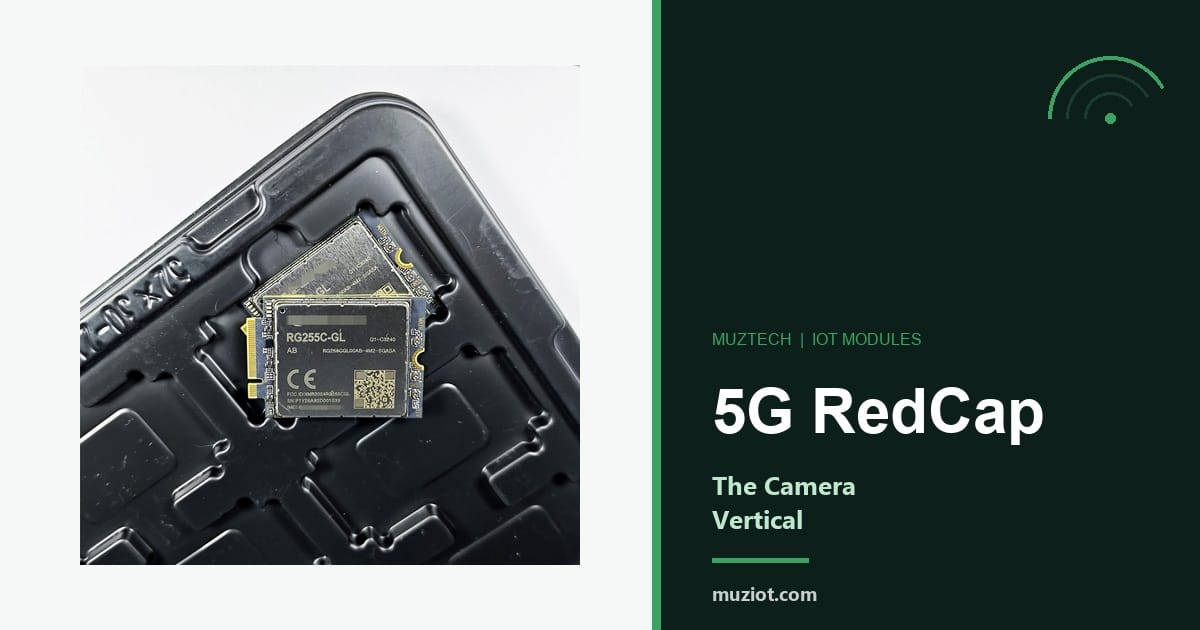
Why 5G RedCap Cameras Are the Next Big IoT Vertical
A camera sits on a construction fence at a site with no fiber and no Wi-Fi. It streams 1080p video over a 5G network, draws less power than a full 5G modem would, and costs a fraction of what that modem costs. Two years ago, a product like this needed an LTE Cat-4 module and a bigger battery. In 2026 it runs on RedCap.
That is not a lab demo. GSA counted 42 operators in 27 countries investing in 5G RedCap as of March 2026, and the association names security and surveillance equipment among the target devices. Commercial RedCap products have shipped since 2024, and the camera is the vertical where the technology finally makes obvious sense.
This article explains why surveillance fits RedCap better than any other category, what the module ecosystem looks like today, and the checklist to run before you design a 5G camera.
The bandwidth math works
Video is the honest test for RedCap, because it needs real throughput, not just connectivity.
A 1080p stream encoded with H.265 runs at roughly 2 to 8 Mbps depending on the scene. Even a multi-camera gateway stays under 30 Mbps in most configurations. RedCap delivers a theoretical 220 to 227 Mbps downlink and 100 to 123 Mbps uplink on the current chipsets, with real-world downloads typically landing between 50 and 150 Mbps. That is an order of magnitude more headroom than the stream needs.
Compare that with the alternatives. LTE Cat-1 bis peaks around 10 Mbps, which forces low bitrates, event-triggered clips, or heavy on-device compression. Full 5G and Cat-4 handle the video fine, but they cost more, draw more power, and need more antenna complexity than a fixed camera requires. RedCap sits in the middle by design: enough bandwidth for real video, with 1T2R antenna operation instead of the 4×4 MIMO that drives up full 5G cost.
Two 5G features matter for surveillance specifically. Network slicing lets an operator reserve bandwidth for the video stream, which helps when the camera shares a cell with phones and industrial traffic. URLLC support, where the network offers it, tightens latency for the real-time monitoring use cases that cannot tolerate a five-second delay.
The market moved in 2026
The GSA April 2026 update is the reference point. Forty-two operators in 27 countries are investing in RedCap, commercial services are live in multiple markets, and Rogers is mid-deployment in Canada. Telefonica and Deutsche Telekom both expanded their RedCap plans since the previous GSA snapshot in September 2025. This is no longer a test-network story.
The module ecosystem matured with the networks. Qualcomm’s Snapdragon X35 was the first commercial RedCap modem and remains the dominant choice, with ABI Research counting it in 39 percent of RedCap module launches; MediaTek’s T300 and M60 are the main alternative. You can now buy RedCap modules from Quectel, Fibocom, Telit Cinterion, SIMCom and MeiG, in LGA and M.2 forms, almost all with LTE Cat-4 fallback for the years when 5G standalone coverage is still patchy.
Industrial routers got there first. Teltonika’s RUT271, Digi’s IX20 and EX15 with RedCap upgrade paths, and PLANET’s 5G NR gateway are all shipping. On the device side, TCL’s LINKPORT IK511 dongle is sold through T-Mobile US, and the camera makers are the next wave. That is the pattern: infrastructure first, gateways second, then the vertical devices.
Where RedCap cameras actually win
The obvious deployments are the ones without infrastructure. Construction sites, farms, parking lots, remote depots, border and perimeter monitoring, and temporary security setups all share the same problem: no fiber, no Wi-Fi, and a camera that still needs to stream.
Solar and battery cameras are the interesting case. A camera that uploads a continuous 1080p stream will drain any battery, RedCap or not. The practical design is event-triggered, what Digi calls video-lite: the camera stays asleep, wakes on motion, uploads a clip, and goes back to sleep. RedCap’s power profile is far friendlier than full 5G for this pattern, and the LTE Cat-4 fallback keeps the camera alive in coverage gaps.
Multi-camera sites benefit too. One RedCap gateway can aggregate several IP cameras and upload the mix over a single link, which keeps the per-device cost down and the deployment simple. Network slicing matters most here, because aggregate video traffic competes with everything else on the cell.
The module checklist
Before you design a RedCap camera, run these questions:
- LGA or M.2? LGA modules solder into a custom board and suit volume products. M.2 cards drop into a standard slot and suit gateways and fast prototypes. Choose by roadmap, not by what is cheapest today.
- Does it fall back to LTE Cat-4? Almost all current modules do. Verify the regional variants cover the bands your target markets actually use, since 5G SA coverage is still expanding.
- What is the antenna plan? RedCap uses 1T2R, so the antenna is simpler than full 5G, but a fixed outdoor camera still benefits from a 5 to 9 dBi antenna with a proper mount. Do not reuse an old 4G antenna without checking the 5G bands.
- How will you manage the fleet? Cameras get deployed in bulk and updated rarely, which makes remote management worth the setup cost. An eSIM with SGP.32 support lets you switch operators without touching hardware, and our eSIM guide covers what to check on the module.
- Does the operator support slicing? If you are building for a specific carrier or private network, confirm RedCap slicing and URLLC are enabled before you promise QoS in the datasheet.
When not to use RedCap
A camera bolted to a building with wired Ethernet does not need cellular at all. A fixed indoor deployment with good Wi-Fi coverage is cheaper on both hardware and data. And if the product is not a camera, if it is a sensor that sends a few bytes a day, RedCap is overkill; the LPWAN options like NB-IoT and LTE-M are built for exactly that, and our LPWAN guide explains the tradeoffs.
The rule of thumb: RedCap earns its place when the device moves video and the site lacks infrastructure. That is a large and growing slice of the surveillance market, and it is why the camera vertical is the one to watch.
The short version
RedCap is not a cheaper way to do what LTE already does. It is the first cellular tier that matches video surveillance on bandwidth, power and price at the same time. The network count is real, the modules are shipping, and the camera vendors are the next wave of devices. If your next product is a camera that has to work where there is no cable, this is the year to design it around RedCap.
We stock the SIMCOM, Quectel and Fibocom LTE and 5G lines, including RedCap modules, and we can match bands, form factor and fallback options against your target markets. Send your BOM, or describe the camera you are planning, and we will tell you which module to evaluate.
Browse all module datasheets in our Datasheet Center.
Related module
Quectel RG255C (5G RedCap): specs available in the Datasheet Center (datasheet on request).
Sources
- GSA, "5G RedCap, April 2026, Industry Update" (https://gsacom.com/paper/5g-redcap-april-2026-industry-update)
- GSA, "5G RedCap: Accelerating the Next Phase of Cellular IoT Growth" (https://gsacom.com/industry-insights/5g-redcap-accelerating-the-next-phase-of-cellular-iot-growth)
- 5G RedCap Hub, "5G RedCap Hardware Guide: Chipsets, Modules, Routers & Devices" (https://5gredcap.co.uk/5g-redcap-hardware)
- ABI Research, "5G RedCap: Simplifying Cellular Connectivity for IoT Devices" (https://www.abiresearch.com/blog/5g-redcap)
- HiCellTek, "5G RedCap in April 2026: who is deploying, what changes for testing" (https://hicelltek.com/en/blog/5g-redcap-april-2026-deployment-device-validation-field-guide)
- Digi International, "Understanding 5G RedCap: Simplified 5G for IoT" (https://www.digi.com/solutions/by-technology/5g-redcap)
- Keysight, "RedCap: Cellular IoT for the 5G Era" (https://www.keysight.com/us/en/cmp/2025/redcap.html)